Composer · Baroque · 1660–1725
Alessandro Scarlatti
Italian Baroque composer (1660–1725).
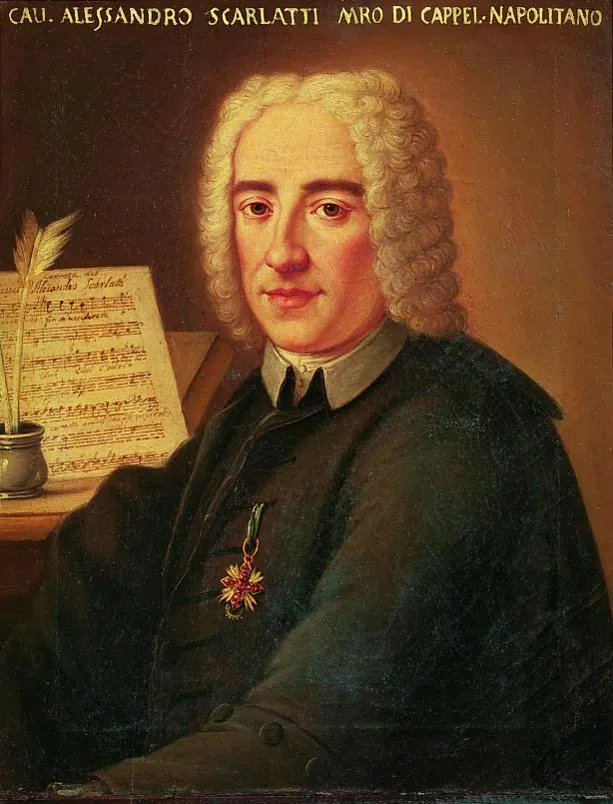
Biography
Pietro Alessandro Gaspare Scarlatti (2 May 1660 – 22 October 1725) was an Italian Baroque composer, known especially for his operas and chamber cantatas. He is considered the most important representative of the Neapolitan School of opera.
Nicknamed by his contemporaries "the Italian Orpheus", he divided his career between Naples and Rome; a significant part of his works was composed for the papal city. He is often considered the founder of the Neapolitan School, although he has only been its most illustrious representative: his contribution, his originality and his influence were essential, as well as lasting, both in Italy and in Europe.
Particularly known for his operas, he brought the Italian dramatic tradition to its maximum development, begun by Monteverdi at the beginning of 17th century and continued by Cesti, Cavalli, Carissimi, Legrenzi and Stradella, designing the final form of the da capo aria, imitated throughout Europe. He was also the inventor of the Italian overture in three movements (which was of the highest importance in the development of the symphony), of the four-part sonata (progenitor of the modern string quartet), and of the technique of motivic development. He was a model for the musical theatre of his time, as evoked by Handel's Italian works, who was deeply influenced by his theatrical music. Eclectic, Scarlatti also worked on all the other common genres of his time, from the sonata to the concerto grosso, from the motet to the mass, from the oratorio to the cantata, the latter being a genre in which he was an undisputed master.
Text adapted from the Wikipedia article “Alessandro Scarlatti”, licensed under CC BY-SA 4.0.
Works with flute
- Ardo, è ver, per te d'amore, chamber cantata for soprano, flute and continuo
- Augellin vago e canoro, chamber cantata for soprano, 2 flutes, and continuo
- Flute Concerto in D
- Flute Sonata in G
- Flute Suite in F
- Humanità e Lucifero, oratorio for soprano, tenor, piccolo, trumpet, strings and continuo
- La Giuditta, oratorio for soloists, 2 flutes, trumpet, trombones, strings and continuo
- Quella pace gradita, chamber cantata for soprano, flute, violin, cello and continuo
- Sinfonie di concerto grosso no. 1 in F major, for 2 flutes, 2 violins, viola, cello and continuo
- Sinfonie di concerto grosso no. 2 in D major, for flute, trumpet, 2 violins, viola, cello and continuo
- Sinfonie di concerto grosso no. 3 in D minor, for flute, 2 violins, viola, cello and continuo
- Sinfonie di concerto grosso no. 4 in E minor, for flute, oboe, 2 violins, viola, cello and continuo
- Sonata in A major, for 2 flutes, 2 violins and continuo
- Sonata in F for 3 Flutes and Continuo
- Sonata in F for Flute, 2 Violins and Continuo
- Sonata no. 1, for flute and chamber ensemble
- Sonata no. 2 in A minor, for flute, 2 violins, cello and continuo
- Tu sei quella che al nome, chamber cantata for alto, 2 violins, flute and continuo, "Bella donna di nome santa"
Works with oboe
- Abramo, il tuo sembiante, cantata for soloists, chorus, 2 oboes, strings and continuo
- Audi filia, et inclina aurem, for chorus, oboe, 2 violins, viola, and organ
- Sinfonie di concerto grosso no. 4 in E minor, for flute, oboe, 2 violins, viola, cello and continuo
Works with recorder
- Filli, tu sai s'io t'amo, for soprano, 2 recorders and continuo
- Sonata in F major, for recorder and continuo