Composer · 20th Century · 1874–1951
Arnold Schoenberg
Austrian-American composer (1874–1951).
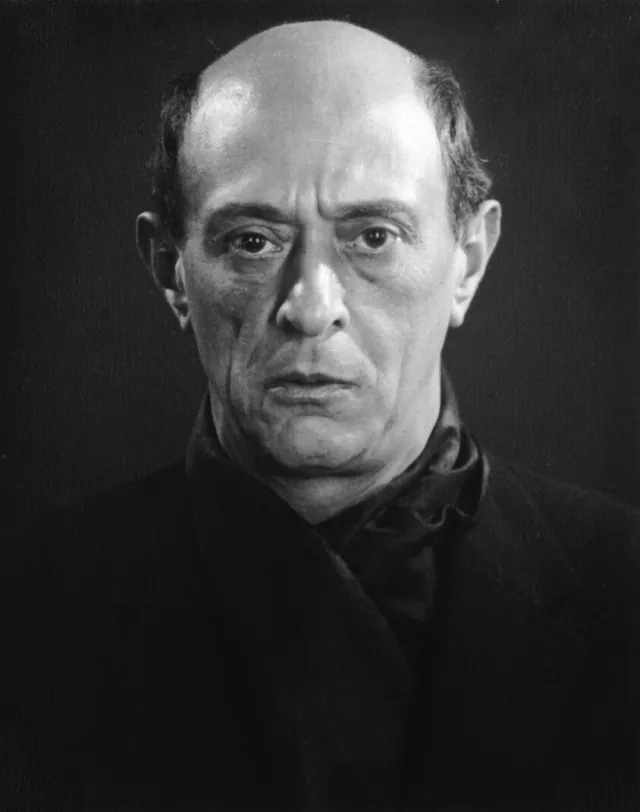
Biography
Arnold Schoenberg or Schönberg (13 September 1874 – 13 July 1951) was an Austrian and American modernist composer, music theorist, and teacher associated with developing variation, the emancipation of the dissonance, and twelve-tone composition. He taught composition in Vienna and at the Prussian Academy of Arts (1925–1933), resigning in anticipation of Nazi Germany's civil–service restrictions. He defiantly reaffirmed his Judaism before immigrating to the United States, where he taught at the University of California, Los Angeles (1936–1944).
Early works like Verklärte Nacht (1899) and Gurre-Lieder (1900–1903, orch. 1910–1911) represented a synthesis of Johannes Brahms and Richard Wagner, while Richard Strauss influenced Pelleas und Melisande (1902–1903). Schoenberg mentored Anton Webern and Alban Berg, among others tied to the Second Viennese School, and they began writing atonal, expressionist music. He visited extremes of emotion in his String Quartet No. 2 (1907–1908) and Erwartung (1909), and used word painting structurally in Herzgewächse (1911, published with his other works in Der Blaue Reiter Almanach in 1912) and Pierrot lunaire (1912). As opposition and antisemitism gradually deepened his sense of outsider, Jewish identity, he underwent a spiritual turn inspired partly by Gustav Mahler, began Die Jakobsleiter (planned from 1912), and sought a large-scale governing principle like tonality.
He arrived at twelve-tone technique by 1923 and structured works like Moses und Aron (planned from 1923) and the Variations for Orchestra (1926–1928) by extending the logic of developing variation to row-derived intervallic motives (or cells), sometimes in tonally suggestive ways and often organized through combinatorial hexachords. Begleitungsmusik zu einer Lichtspielscene (1929–1930) showed his interest in film, and the Chamber Symphony No. 2 (1939) his continued interest in tonal composition. With U.S. citizenship (1941) and U.S. entry into World War II, he satirized fascist leaders in his twelve-tone Ode to Napoleon (1942, after Byron), quoting Beethoven's fate motif alongside "La Marseillaise" before concluding with an E-flat-major triad.
Text adapted from the Wikipedia article “Arnold Schoenberg”, licensed under CC BY-SA 4.0.
Works with bassoon
- Wind Quintet (1924) · free score
Works with clarinet
- Wind Quintet (1924) · free score
- Berceuse elegiaque, for piano quintet, flute, clarinet, piano and harmonium
- Emperor Waltz, for string quartet, flute, clarinet and piano
Works with flute
- Wind Quintet (1924) · free score
- Berceuse elegiaque, for piano quintet, flute, clarinet, piano and harmonium
- Emperor Waltz, for string quartet, flute, clarinet and piano
Works with oboe
- Wind Quintet (1924) · free score