Composer · Baroque · 1685–1759
George Frideric Handel
German-British composer (1685–1759).
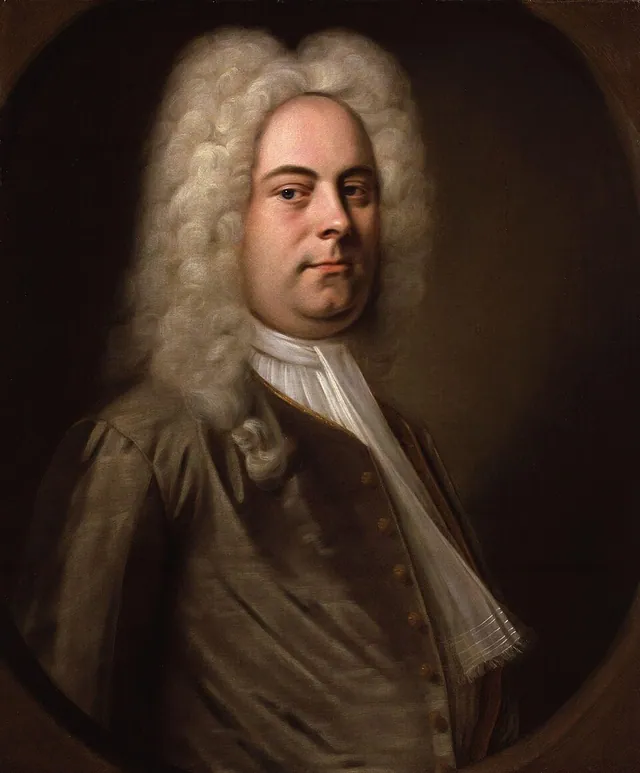
Biography
George Frideric (or Frederick) Handel ( HAN-dəl; baptised Georg Fried[e]rich Händel, German: [ˈɡeːɔʁk ˈfʁiːdʁɪç ˈhɛndl̩] ; 5 March 1685 [O.S. 23 February 1684] – 14 April 1759) was a German-British Baroque composer well-known for his operas, oratorios, anthems, concerti grossi, and organ concerti.
Born in Halle, Handel spent his early life in Hamburg and Italy before settling in London in 1712, where he spent the bulk of his career and became a naturalised British subject in 1727. He was strongly influenced both by the middle-German polyphonic choral tradition and by composers of the Italian Baroque. In turn, Handel's music forms one of the peaks of the "high baroque" style, bringing Italian opera to its highest development, creating the genres of English oratorio and organ concerto, and introducing a new style into English church music. He is consistently recognised as one of the greatest composers of his age.
Handel started three commercial opera companies to supply the English nobility with Italian opera. In 1737 he had a physical breakdown, changed direction creatively, addressed the middle class and made a transition to English choral works. After his success with Messiah (1742), he never composed an Italian opera again. His orchestral Water Music and Music for the Royal Fireworks remain steadfastly popular. One of his four coronation anthems, Zadok the Priest, has been performed at every British coronation since 1727. He died a respected and rich man in 1759, aged 74, and was given a state funeral at Westminster Abbey.
Text adapted from the Wikipedia article “George Frideric Handel”, licensed under CC BY-SA 4.0.
Works with flute
- Flute Sonata in E minor, op. 1, no. 1b, HWV.359b
- Flute Sonata in E minor, op. 1, no. 1a, HWV.379
- Flute sonata in B minor HWV 367b · free score
- Flute sonata in B minor HWV 376 · free score
- Flute sonata in D major HWV 378
- Flute sonata in E minor HWV 359b · free score
- Flute sonata in E minor HWV 375 · free score
- Flute sonata in E minor HWV 379 · free score
- Flute sonata in G major HWV 363b · free score
- Handel flute sonatas
Works with oboe
- Oboe Concerto No. 3 (1700) · free score
- Oboe Concerto No. 1 (1710) · free score
- Oboe Sonata in C minor (1710) · free score
- Oboe Sonata in F major (1710)
- Air in G minor, for oboe and orchestra
- Ero e Leandro, for soprano, 2 oboes, strings and continuo, HWV.150
- Largo in F major, for oboe, 2 horns, strings and continuo, HWV.302b
- Oboe Concerto No. 2 · free score
- Oboe Concerto in F major, HWV.331
- Oboe Concerto no. 1 in B flat major, HWV.302a
- Oboe Sonata in B flat major, HWV.357
- Oboe Sonata in F major, HWV.363a
- Rondo in G major, for oboe and orchestra
- Saeviat tellus inter rigores, for soprano, 2 oboes, strings and continuo, HWV.240
- Suite in G minor, for two oboes and orchestra
Works with recorder
- Concerto in B flat major, for lutes, strings and recorders
- Pensieri notturni di filli, for soprano, recorder, and continuo, HWV.134, "Nel dolce dell'oblio"
- Recorder Sonata in A minor, op. 1, no. 4, HWV.362
- Recorder Sonata in D minor, op. 1, no. 9a, HWV.367a
- Trio Sonata in F for 2 Recorders and Continuo, HWV.405