Composer · Early Romantic · 1792–1868
Gioachino Rossini
Italian opera composer (1792–1868).
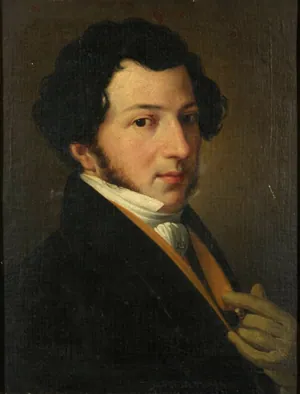
Biography
Gioachino Antonio Rossini (29 February 1792 – 13 November 1868) was an Italian composer and conductor of the late Classical and early Romantic eras. While he gained most of his fame for his 39 operas, he also wrote many pieces of chamber music, piano, and some sacred music. He set new standards for both comic and serious opera before retiring from large-scale composition while still in his thirties, at the height of his popularity.
Born in Pesaro to parents who were both musicians (his father a trumpeter, his mother a singer), Rossini began to compose by the age of twelve and was educated at music school in Bologna. His first opera was performed in Venice in 1810 when he was 18 years old. In 1815 he was engaged to write operas and manage theatres in Naples. In the period 1810–1823, he wrote 34 operas for the Italian stage that were performed in Venice, Milan, Ferrara, Naples and elsewhere; this productivity necessitated an almost formulaic approach for some components (such as overtures) and a certain amount of self-borrowing. During this period he produced his most popular works, including the comic operas L'italiana in Algeri, Il barbiere di Siviglia (known in English as The Barber of Seville) and La Cenerentola, which brought to a peak the opera buffa tradition he inherited from masters such as Wolfgang Amadeus Mozart, Domenico Cimarosa and Giovanni Paisiello. He also composed opera seria works such as Tancredi, Otello and Semiramide. All of these attracted admiration for their innovation in melody, harmonic and instrumental colour, and dramatic form. In 1824 he was contracted by the Opéra in Paris, for which he produced an opera to celebrate the coronation of Charles X, Il viaggio a Reims (half the music of which was later reused for his first opera in French, Le comte Ory), revisions of two of his Italian operas, Le siège de Corinthe and Moïse, and in 1829 his last opera, Guillaume Tell.
Rossini's withdrawal from opera for the last 40 years of his life has never been fully explained; contributory factors may have been ill-health, the wealth his success had brought him, and the rise of spectacular grand opera under composers such as Giacomo Meyerbeer. From the early 1830s to 1855, when he left Paris and was based in Bologna, Rossini wrote relatively little. On his return to Paris in 1855 he became renowned for his musical salons on Saturdays, regularly attended by musicians and the artistic and fashionable circles of Paris, for which he wrote the entertaining pieces Péchés de vieillesse. Guests included Franz Liszt, Anton Rubinstein, Giuseppe Verdi, Meyerbeer, and Joseph Joachim. Rossini's last major composition was his Petite messe solennelle (1863).
Text adapted from the Wikipedia article “Gioachino Rossini”, licensed under CC BY-SA 4.0.
Works with bassoon
- Andante, Theme and Variations, for flute, clarinet, horn and bassoon in F major, QR vi/18
- Concerto for Bassoon and Orchestra, "Concerto da Esperimento"
Works with clarinet
- Andante, Theme and Variations, for flute, clarinet, horn and bassoon in F major, QR vi/18
- Fantasie in E flat major, for clarinet and piano
- Introduction, Theme and Variations for Clarinet and Orchestra from La Donna del lago, QR vi/57
- Introduction, thème et variations · free score
- Variations for Clarinet and Orchestra, QR vi/57
- Variazioni a più istrumenti obbligati in F major, for 2 violins, viola, cello and clarinet, QR ix/1
Works with flute
- Andante, Theme and Variations, for flute, clarinet, horn and bassoon in F major, QR vi/18
- Ranz des Vaches
- Serenata for 2 Violins, Viola, Cello, Flute, Oboe and English horn in E flat major, QR vi/31
Works with oboe
- Serenata for 2 Violins, Viola, Cello, Flute, Oboe and English horn in E flat major, QR vi/31
Works with saxophone
- Rossini...per quattro, for saxophones