Composer · Baroque · 1685–1750
Johann Sebastian Bach
German composer (1685–1750).
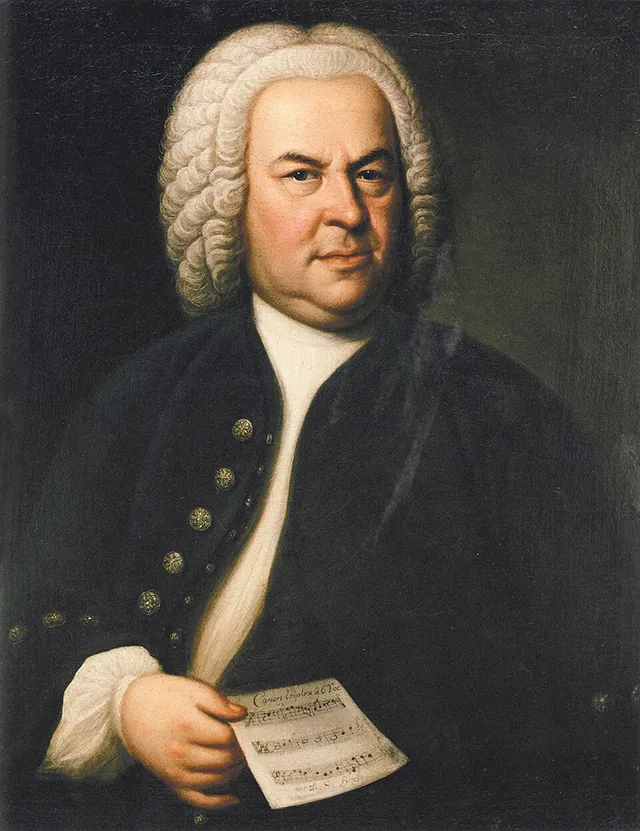
Biography
Johann Sebastian Bach (31 March [O.S. 21 March] 1685 – 28 July 1750) was a German composer and musician of the late Baroque period. He is known for his prolific output across a variety of instruments and forms, including the orchestral Brandenburg Concertos; solo instrumental works such as the Cello Suites and Sonatas and Partitas for Solo Violin; keyboard works such as the Goldberg Variations and The Well-Tempered Clavier; organ works such as the Schübler Chorales and the Toccata and Fugue in D minor; and choral works such as the St. Matthew Passion and the Mass in B minor. He is known for his mastery of counterpoint, as heard in The Musical Offering and The Art of Fugue. Felix Mendelssohn precipitated the Bach Revival with a performance of the St. Matthew Passion in 1829. Ever since, Bach has been acclaimed as one of the greatest composers in the history of Western music.
The Bach family had already produced several composers when Johann Sebastian was born in Eisenach, the youngest child of the city musician Johann Ambrosius Bach. After being orphaned at age 10, he lived for five years with his eldest brother, Johann Christoph, then continued his musical education in Lüneburg. In 1703 he returned to Thuringia, working as a musician for Protestant churches in Arnstadt and Mühlhausen. Around that time he also paid extended visits to the courts in Weimar, where he expanded his organ repertory, and the reformed court at Köthen, where he was mostly engaged with chamber music. By 1723 he was hired as Thomaskantor, church music director of the city of Leipzig and thus responsible for music in four Lutheran city churches and for the St. Thomas School. He decided to compose annual cycles of church cantatas, and also wrote music for Leipzig University's student ensemble, Collegium Musicum. In 1726 he began publishing his organ and other keyboard music. In Leipzig, he had difficult relations with his employer, as he had during some of his earlier positions. This situation was somewhat remedied when his sovereign, Augustus III of Poland, granted him the title of court composer of the Elector of Saxony in 1736. In the last decades of his life, Bach reworked and extended many of his earlier compositions. He died due to complications following eye surgery in 1750 at the age of 65. Four of his twenty children, Wilhelm Friedemann, Carl Philipp Emanuel, Johann Christoph Friedrich, and Johann Christian, became composers.
Bach enriched established German styles through his mastery of counterpoint, harmonic and motivic organisation, and his adaptation of rhythms, forms, and textures from abroad, particularly Italy and France. His compositions include hundreds of cantatas, both sacred and secular. He composed Latin church music, Passions, oratorios, and motets. He adopted Lutheran hymns, not only in his larger vocal works but also in such works as his four-part chorales and his sacred songs. Bach wrote extensively for organ and other keyboard instruments. He composed concertos, for instance for violin and for harpsichord, and suites, as chamber music as well as for orchestra. Many of his works use contrapuntal techniques like canon and fugue.
Text adapted from the Wikipedia article “Johann Sebastian Bach”, licensed under CC BY-SA 4.0.
Works with bassoon
- Concerto in D for 3 Trumpets, 3 Oboes, Bassoon, and Timpani, BWV.deest
Works with flute
- Sonata in A major for flute or recorder and harpsichord (1736) · free score
- Sonata in B minor for flute or recorder and harpsichord (1736) · free score
- Der Gerechte kömmt um, motet a5, for 2 flutes, 2 oboes, strings, and continuo, BWV. deest
- Er hat sein Volk getröst't
- Flute Sonata no. 1 in B minor, BWV.1030
- Flute sonatas by Johann Sebastian Bach
- Herrscher des Himmels, erhöre das Lallen
- II. Und es waren Hirten in derselben Gegend
- III. Herrscher des Himmels, erhöre das Lallen
- Ja, ja! mein Herz soll es bewahren
- Jauchzet, frohlocket, auf, preiset die Tage
- Lasset uns nun gehen gen Bethlehem
- Partita in A minor for Solo Flute, BWV.1013
- Partita in A minor for solo flute
- Sonata in E major for flute or recorder and basso continuo · free score
- Sonata in E-flat major for flute or recorder and harpsichord · free score
- Sonata in G major for 2 flutes and basso continuo · free score
- Sonata in g for violin (or flute) and basso continuo
- Trio Sonata in G for 2 Flutes and Continuo, BWV.1039
- Trio Sonata in G major, BWV 1038 · free score
- Triple Concerto in A minor, for Flute, Violin and Keyboard, BWV.1044
- Wie soll ich dich empfangen
Works with oboe
- Ach mein herzliebes Jesulein
- Adagio du Concerto pour hautbois en ré mineur
- Concerto in D for 3 Trumpets, 3 Oboes, Bassoon, and Timpani, BWV.deest
- Concerto in D minor for Harpsichord, Oboe, Strings and Continuo in D minor, BWV.1059
- Der Gerechte kömmt um, motet a5, for 2 flutes, 2 oboes, strings, and continuo, BWV. deest
- Double Concerto in C minor for Oboe and Violin, BWV.1060R
- Herrscher des Himmels, erhöre das Lallen
- I. Jauchzet, frohlocket, auf, preiset die Tage
- III. Herrscher des Himmels, erhöre das Lallen
- IV. Fallt mit Danken, fallt mit Loben
- Jauchzet, frohlocket, auf, preiset die Tage
- Oboe Concerto in D minor, BWV.1059R
- Oboe d'amore Concerto in A major, BWV.1055R
- Suite No. 3 - Ouverture
- Wie soll ich dich empfangen