Composer · Early Romantic · 1770–1827
Ludwig van Beethoven
German composer (1770–1827).
Biography
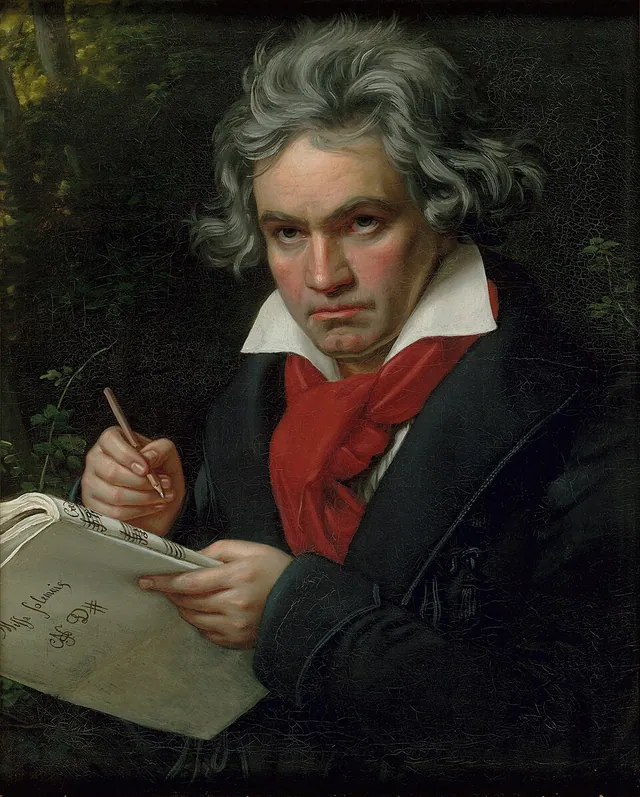
Ludwig van Beethoven (baptised 17 December 1770 – 26 March 1827) was a German composer, conductor, and pianist. Regarded as one of the greatest composers in the history of Western music, he was mentored during the Classical period, and his musical style was a key driver of the transition to Romantic music, and the expansion of instrumental forms such as the symphony, the piano sonata and the string quartet. His compositions have attracted extraordinary casual and scholarly interest, and remain among the most performed in the world.
Born in Bonn, Beethoven was a musical prodigy. He was initially taught intensively by his father, Johann van Beethoven, and later by Christian Gottlob Neefe. He found relief from a dysfunctional home life with the family of Helene von Breuning, whose children he loved, befriended, and taught piano. At age 21, he moved to Vienna, which became his base, and studied composition with Joseph Haydn. Beethoven gained a reputation as a virtuoso pianist, and was soon patronized by Karl Alois, Prince Lichnowsky for compositions, which resulted in his three Piano Trios, Op. 1, the earliest works to which he accorded an opus number, in 1795. His Pathétique Sonata was composed in 1798. Around this time, Beethoven began experiencing symptoms of hearing loss.
His career is divided into three periods. In the first, he composed in the classical style of Haydn and Wolfgang Amadeus Mozart. Beethoven's First Symphony premiered in 1800, and his first set of string quartets was published in 1801. The Moonlight Sonata, dedicated to his pupil Julie Guicciardi, is one of his most popular works. In the middle period (1802–1812), he developed a distinctive style. His Third (Eroica) and Fifth Symphonies premiered in 1805 and 1808, respectively. The former was unprecedented in scale and scope. His opera, Fidelio, premiered in 1805, and was later revised. His Violin Concerto appeared in 1806. His Razumovsky quartets were published in 1808. Other middle works include the Waldstein and Appassionata sonatas for piano, the Kreutzer sonata for violin and his Seventh Symphony. His Emperor piano concerto premiered in 1811, without the composer as soloist.
Text adapted from the Wikipedia article “Ludwig van Beethoven”, licensed under CC BY-SA 4.0.
Works with bassoon
- Trio for Piano, Flute and Bassoon (1786)
- Octet in E-flat Major, Op. 103 (1792) · free score
- Quintet for Piano and Winds (1796) · free score
- Septet (1799) · free score
- Meeresstille und glückliche Fahrt (1814) · free score
- Duo for Clarinet and Bassoon in C major, WoO 27 no. 1
- Quintet for Piano and Winds in E flat major, op. 16 — For piano, oboe, clarinet, horn and bassoon
- Romance cantabile in E minor, Hess13 — For flute, bassoon and orchestra
- Septet in E flat major, op. 20 — For clarinet, horn, bassoon, violin, viola, cello and double bass
- Trio in G major, WoO 37 — For flute, bassoon and piano
- Wind Quintet in E flat major, Hess 19 — For oboe, 3 horns and bassoon
Works with clarinet
- Musik zu einem Ritterballett (1791) · free score
- Octet in E-flat Major, Op. 103 (1792) · free score
- Quintet for Piano and Winds (1796) · free score
- Septet (1799) · free score
- Meeresstille und glückliche Fahrt (1814) · free score
- Clarinet Trio in B flat major, op. 11, "Gassenhauer"
- Clarinet Trio in E flat major, op. 38 — Version for clarinet, cello and piano of the Septet, op. 20
- Duo for Clarinet and Bassoon in C major, WoO 27 no. 1
- Mödlinger Tänze, WoO 17 — For 2 clarinets, 2 horns, 2 violins and double bass
- Piano Trio in B-flat Major, Op. 11 · free score
- Piano Trio, Op. 38
- Quintet for Piano and Winds in E flat major, op. 16 — For piano, oboe, clarinet, horn and bassoon
- Septet in E flat major, op. 20 — For clarinet, horn, bassoon, violin, viola, cello and double bass
Works with flute
- Trio for Piano, Flute and Bassoon (1786)
- Duo for 2 Flutes in G major, WoO 26
- Flute Sonata in B flat major, Anh.4
- National Airs with Variations, op. 105 — For flute and piano
- Romance cantabile in E minor, Hess13 — For flute, bassoon and orchestra
- Serenade in D major, op. 25 — For flute, violin and viola
- Serenade in D major, op. 41 — Version for flute and piano of the Serenade, op. 25
- Ten National Airs with Variations for Flute and Piano
- Trio in G major, WoO 37 — For flute, bassoon and piano
- Variations on a Theme from The Magic Flute, WoO 46 — For cello and piano
- Variations on a Theme from The Magic Flute, op. 66 — For cello and piano
Works with oboe
- Octet in E-flat Major, Op. 103 (1792) · free score
- Quintet for Piano and Winds (1796) · free score
- Meeresstille und glückliche Fahrt (1814) · free score
- Quintet for Piano and Winds in E flat major, op. 16 — For piano, oboe, clarinet, horn and bassoon
- Trio in C major, op. 87 — For 2 oboes and english horn
- Variations on La ci darem la mano, WoO 28 — For 2 oboes and english horn
- Wind Quintet in E flat major, Hess 19 — For oboe, 3 horns and bassoon