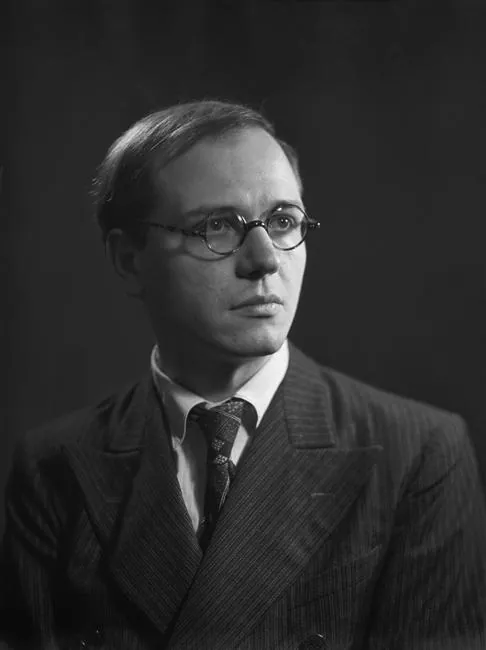
Biography
Olivier Eugène Prosper Charles Messiaen (UK: , US: ; French: [ɔlivje øʒɛn pʁɔspɛʁ ʃaʁl mɛsjɑ̃]; 10 December 1908 – 27 April 1992) was a French composer, organist, and ornithologist. One of the major composers of the 20th century, he was also an outstanding teacher of composition and musical analysis.
Messiaen entered the Conservatoire de Paris at age 11 and studied with Paul Dukas, Maurice Emmanuel, Charles-Marie Widor and Marcel Dupré, among others. He was appointed organist at the Église de la Sainte-Trinité, Paris, in 1931, a post he held for 61 years, until his death. He taught at the Schola Cantorum de Paris during the 1930s. After the fall of France in 1940, Messiaen was interned for nine months in the German prisoner of war camp Stalag VIII-A, where he composed his Quatuor pour la fin du temps (Quartet for the End of Time) for the four instruments available in the prison—piano, violin, cello and clarinet. The piece was first performed by Messiaen and fellow prisoners for an audience of inmates and prison guards. Soon after his release in 1941, Messiaen was appointed professor of harmony at the Paris Conservatoire. In 1966, he was appointed professor of composition there, and he held both positions until retiring in 1978. His many distinguished pupils included Iannis Xenakis, Mikis Theodorakis, George Benjamin, Alexander Goehr, Pierre Boulez, Jacques Hétu, Gérard Grisey, Tristan Murail, Karlheinz Stockhausen, György Kurtág, and Yvonne Loriod, who became his second wife.
Messiaen perceived colours when he heard certain musical chords (a phenomenon known as chromaesthesia); according to him, combinations of these colours were important in his compositional process. He travelled widely and wrote works inspired by diverse influences, including Japanese music, the landscape of Bryce Canyon in Utah, and the life of St. Francis of Assisi. His style absorbed many global musical influences, such as Indonesian gamelan (tuned percussion often features prominently in his orchestral works). He found birdsong fascinating, notating bird songs worldwide and incorporating birdsong transcriptions into his music.
Text adapted from the Wikipedia article “Olivier Messiaen”, licensed under CC BY-SA 4.0.
Works with clarinet
- La Transfiguration de Notre-Seigneur Jésus-Christ, for 100 voices, piano, cello, flute, clarinet, xylorimba, vibrophone, marimba, and orchestra, I/48
- Quatuor pour la fin du temps
- Quatuor pour la fin du temps, I/22 — For violin, cello, clarinet and piano
Works with flute
- Le merle noir (1951)
- Concert à quatre, for flute, cello, piano and orchestra, I/62
- La Transfiguration de Notre-Seigneur Jésus-Christ, for 100 voices, piano, cello, flute, clarinet, xylorimba, vibrophone, marimba, and orchestra, I/48
- Le merle noir, for flute and piano, I/37