Woodwinds · Single reed · Saxophone family
Soprano Saxophone
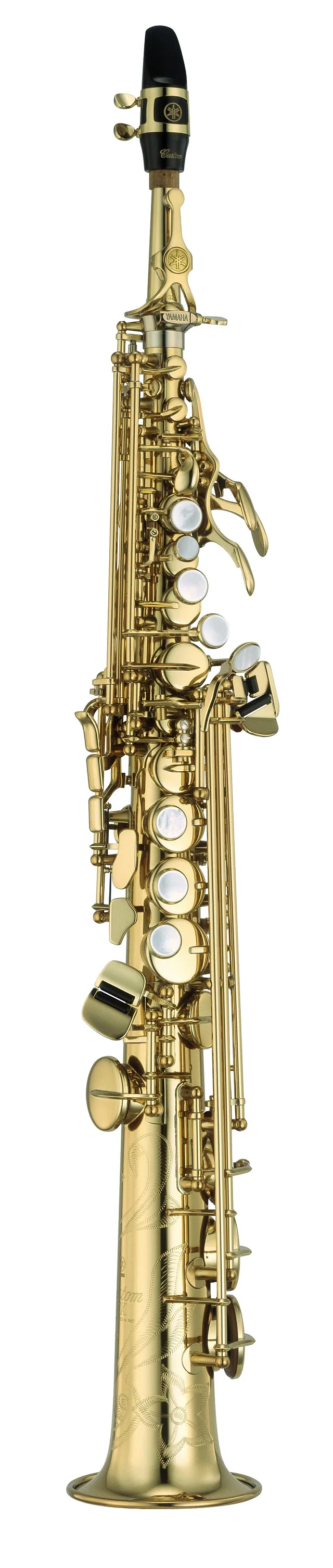
Usually straight; sounds a whole step lower than written.
Quick facts
| Family | Woodwinds — Single reed |
|---|---|
| Hornbostel–Sachs | 422.212-71 |
| Pitched in | B♭ |
| Transposition | Sounds a major second lower than written |
| Written range | B♭3 – F♯6 |
| Sounding range | A♭3 – E6 (207.65 – 1319 Hz) |
| Clef | Treble |
| Inventor | Adolphe Sax |
| Other names | Sopransaxophon, saxofón soprano, saxophone soprano |
Player's notes
- Usually straight; sounds a whole step lower than written.
- Sidney Bechet and John Coltrane made it a jazz voice.
About the soprano saxophone
The soprano saxophone is a small, high-pitched member of the saxophone family of woodwind instruments invented in the 1840s by Belgian instrument maker Adolphe Sax. Built in B♭, an octave above the tenor saxophone (or rarely, slightly smaller in C), the soprano is the smallest of the four saxophones in common use (the others being the alto, tenor and baritone), although there are smaller rare instruments such as the soprillo and sopranino.
Text adapted from the Wikipedia article “Soprano saxophone”, licensed under CC BY-SA 4.0.
Listen
Recordings from Wikimedia Commons, found via Openverse.
Notable repertoire
- méringue — Unknown
- saxophone repertoire — Unknown
Frequently asked questions
What is the range of the soprano saxophone?
The practical written range of the soprano saxophone is B♭3 to F♯6, which sounds A♭3 to E6 (207.7 Hz to 1319 Hz at A4 = 440 Hz).
Is the soprano saxophone a transposing instrument?
Yes. The soprano saxophone is pitched in B♭: sounds a major second lower than written. A written C sounds B♭.
What clef does the soprano saxophone read?
The soprano saxophone reads treble clef.
How is the soprano saxophone classified?
In the Hornbostel–Sachs system the soprano saxophone is classified as 422.212-71.