Cleveland Museum of Art · late 1800s
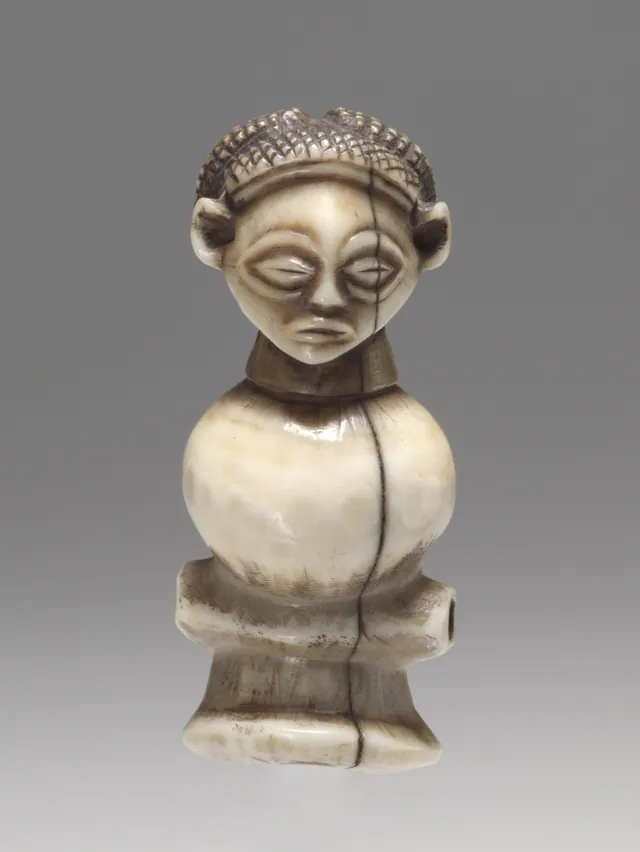
Whistle (kasengosengo)
Carved out of ivory or wood in a variety of shapes, Chokwe whistles often bear miniature, stylized renderings of masks. Cikunza, the "patron saint" of the boys' initiation into manhood, is depicted with a pointed extension imitating the horn of a road antelope, symbolizing the fertility spirit. Typically such whistles were used by men during the hunt to communicate with their co-hunters and to call their dogs. They were either worn attached to a string as a necklace or tied to a spear.
This was the first sculptural work from Africa to enter the CMA's collection.
| Date | late 1800s |
|---|---|
| Culture / origin | Central Africa, Democratic Republic of Congo or Angola, Chokwe people |
| Materials | Probably hippopotamus ivory |
| Dimensions | Overall: 7.3 x 3.2 cm (2 7/8 x 1 1/4 in.) |
| Credit | Educational Purchase Fund |