Cleveland Museum of Art · c. 1850
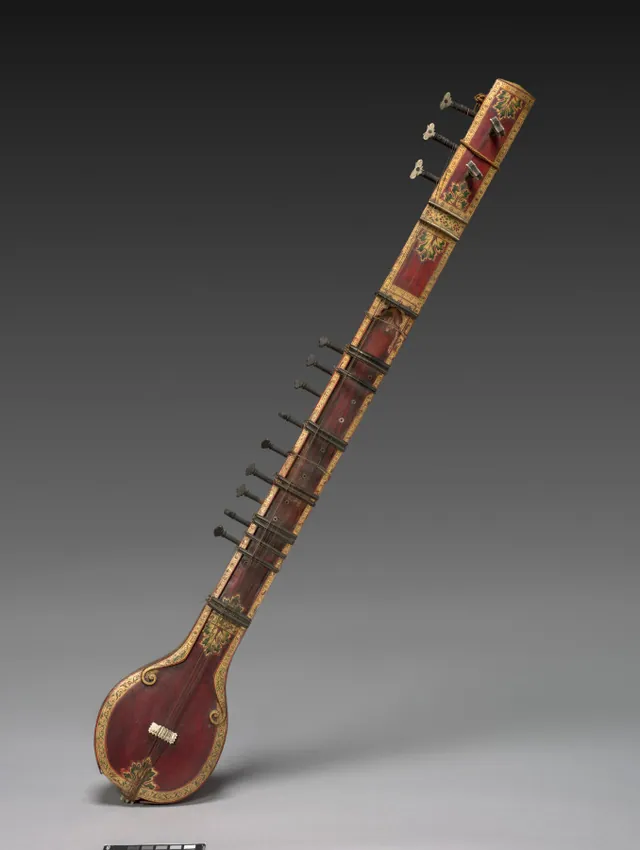
Sitar
The stringed instrument known as the sitar usually provided the central sound for the musical performances that were a constant feature of court life in India. The sitar could then be accompanied by percussion, voice, and other supporting instruments. In Raja Deen Dayal’s photograph Maharaja of Rewa in Prayer ( 2016.266.21 ), a musician strums a sitar in order to please the deities on the royal altar. The improvised compositions are played in a mode, or key, that correlates to the time of day and season of the year.
Many paintings of Indian court life depict female musicians holding and playing this kind of lightweight stringed instrument.
| Date | c. 1850 |
|---|---|
| Culture / origin | Eastern India, Bengal or Bangladesh |
| Materials | Gourd and wood with pigment, ivory, and bone; copper alloy: frets; iron alloy: strings (with one modern copper replacement) |
| Dimensions | Overall: 95.2 x 15.3 cm (37 1/2 x 6 in.) |
| Credit | The Charles G. King Jr. collection; Gift of Ralph King in memory of Charles G. King Jr. |