Cleveland Museum of Art · 1875–1900
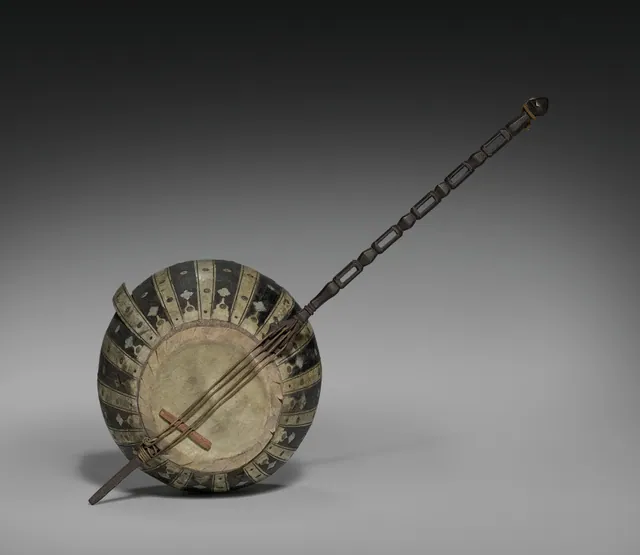
Kamānche (incomplete)
Kamānche is a Persian term first used in the 10th century to describe an instrument that is sounded with a bow. From there, bowed instruments spread to Byzantium, Central Asia, the Far East, and then to Europe. In Egypt, it is known as the rabāb , a term known throughout the Islamic world from North Africa to Southeast Asia. The names of musical instruments often reveal origin, context, or musical function. In Europe, North Africa, and Asia where contact with Middle Eastern culture occurred, variations of Arabic and Persian terms for instruments are widespread. Usually, related names refer to similar instruments; however, this is not always true. Among these "floating terms" are the names zūrna , rabāb, kāmanja , nāy , and dombak .
The instrument's spike would be placed on the ground or today, on the knee, when it was played.
| Date | 1875–1900 |
|---|---|
| Culture / origin | Northern Iran (Caucasian, maybe Azerbaijan, or Kashmir) |
| Materials | Wood, hide, and bone |
| Dimensions | Overall: 58.5 x 26.8 cm (23 1/16 x 10 9/16 in.) |
| Credit | The Charles G. King Jr. collection; Gift of Ralph King in memory of Charles G. King Jr. |