Cleveland Museum of Art · c. 1800
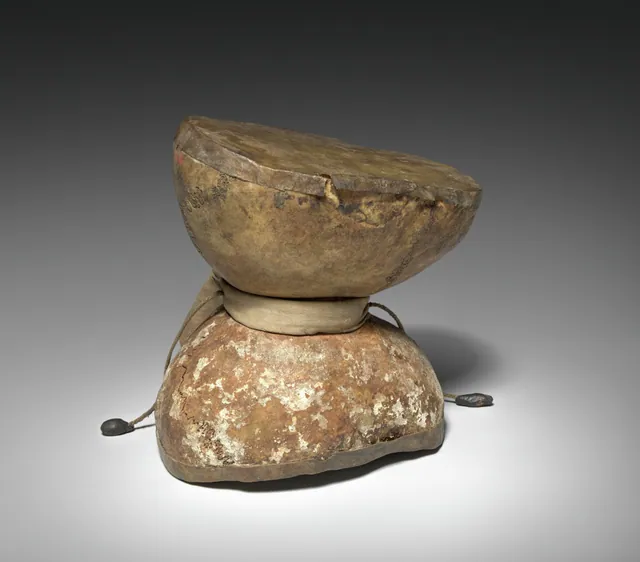
Ritual Drum (damaru)
Damaru drums are made from the tops of two skulls joined in the center and sounded by rapidly turning it side to side so the ends of the cords fly up to sound against the stretched skin. In Hindu and Buddhist rituals, the rhythm of the damaru references the ongoing, relentless beat of time. The material of bone reminds practitioners of the inevitability of death in the course of time.
Dancing Shiva, in his form as Nataraja, holds a damaru in one hand.
| Date | c. 1800 |
|---|---|
| Culture / origin | Tibet |
| Materials | skull bone, cloth, hemp fiber, leather, and skin |
| Dimensions | Overall: 20.4 x 17.8 x 13.1 cm (8 1/16 x 7 x 5 3/16 in.) |
| Credit | The Charles G. King Jr. collection; Gift of Ralph King in memory of Charles G. King Jr. |