Keyboards · Free reed · Keyboards
Accordion
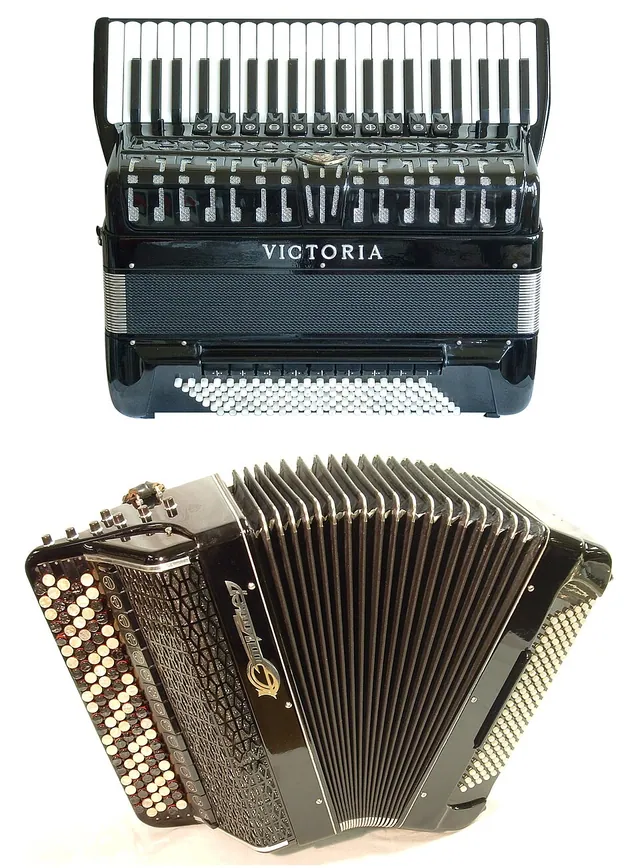
Free-reed instrument driven by a bellows; piano or button keyboard on the treble side.
Quick facts
| Family | Keyboards — Free reed |
|---|---|
| Hornbostel–Sachs | 412.132 |
| Pitched in | C |
| Transposition | Sounds as written (non-transposing) |
| Written range | F3 – A6 |
| Sounding range | F3 – A6 (174.61 – 1760 Hz) |
| Clefs | Treble, Bass |
| First appeared | c. 1829 |
| Origin | France |
| Other names | Accordéon, Akkordeon, acordeón, trekkspill, 🪗 |
Player's notes
- Free-reed instrument driven by a bellows; piano or button keyboard on the treble side.
- Stradella bass buttons supply single notes and ready-made chords.
About the accordion
Accordions (from 19th-century German Akkordeon, from Akkord—"musical chord, concord of sounds") are a family of box-shaped musical instruments of the bellows-driven free reed aerophone type (producing sound as air flows past a reed in a frame). The essential characteristic of the accordion is to combine in one instrument a melody section, also called the diskant, usually on the right-hand keyboard, with an accompaniment or basso continuo functionality on the left-hand. The musician normally plays the melody on buttons or keys on the right-hand side (referred to as the keyboard or sometimes the manual), and the accompaniment on bass or pre-set chord buttons on the left-hand side. A person who plays the accordion is called an accordionist.
The accordion belongs to the free-reed aerophone family. Other instruments in this family include the concertina, harmonica, and bandoneon. The concertina and bandoneon do not have the melody–accompaniment duality. The harmoneon is also related and, while having the descant vs. melody dualism, tries to make it less pronounced. The harmonium and American reed organ are in the same family, but are typically larger than an accordion and sit on a surface or the floor.
The accordion is played by compressing or expanding the bellows while pressing buttons or keys, causing pallets to open, which allow air to flow across strips of brass or steel, called reeds. These vibrate to produce sound inside the body. Valves on opposing reeds of each note are used to make the instrument's reeds sound louder without air leaking from each reed block.
Text adapted from the Wikipedia article “Accordion”, licensed under CC BY-SA 4.0.
Listen
Recordings from Wikimedia Commons, found via Openverse.
Frequently asked questions
What is the range of the accordion?
The practical written range of the accordion is F3 to A6, which sounds F3 to A6 (174.6 Hz to 1760 Hz at A4 = 440 Hz).
Is the accordion a transposing instrument?
No. The accordion sounds at written pitch (concert pitch).
What clef does the accordion read?
The accordion reads treble clef and bass clef.
How is the accordion classified?
In the Hornbostel–Sachs system the accordion is classified as 412.132.