Keyboards · Plucked strings · Keyboards
Harpsichord
Strings are plucked by quills or plastic plectra; no dynamic change from touch.
Quick facts
| Family | Keyboards — Plucked strings |
|---|---|
| Hornbostel–Sachs | 314.122-6-8 |
| Pitched in | C |
| Transposition | Sounds as written (non-transposing) |
| Written range | F1 – F6 |
| Sounding range | F1 – F6 (43.65 – 1397 Hz) |
| Clefs | Treble, Bass |
| First appeared | c. 1500 |
| Other names | Cembalo, clavecin, clavecín, harpischord |
Player's notes
- Strings are plucked by quills or plastic plectra; no dynamic change from touch.
- Often tuned at A = 415 Hz with an unequal temperament for baroque repertoire.
About the harpsichord
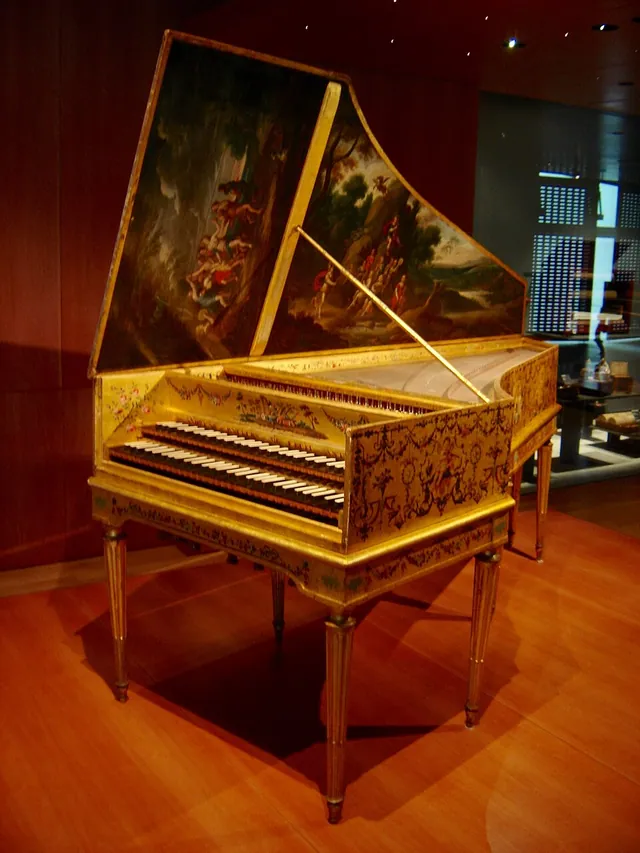
A harpsichord is a keyboard instrument that makes its sound by plucking a set of strings. In a harpsichord, depressing a key raises its back end within the instrument, which in turn lifts one or more jacks, each a thin strip of wood holding a small plectrum made from quill or plastic; each plectrum plucks a single string. The strings are under tension on a soundboard, which is mounted in a wooden case; the soundboard amplifies the vibrations from the strings so that the listeners can hear them. Harpsichord often include more than one choir of strings. Various devices are used to select which choir will sound when playing; these can include simple levers, or in more elaborate instruments the deployment of more than one keyboard.
The term denotes the whole family of similar plucked-keyboard instruments, including the smaller virginals, muselar, and spinet. The harpsichord was widely used in Renaissance and Baroque music, both for purposes of accompaniment and as a solo instrument. During the Baroque era, the harpsichord was a standard part of the continuo group. During the late 18th century, with the spread of the piano, the harpsichord gradually disappeared from the musical scene (except in opera, where it continued to be used to accompany recitative). In the 20th century, it made a resurgence, being used in historically informed performance of older music, in new compositions, and in certain styles of popular music.
Text adapted from the Wikipedia article “Harpsichord”, licensed under CC BY-SA 4.0.
Listen
Recordings from Wikimedia Commons, found via Openverse.
Frequently asked questions
What is the range of the harpsichord?
The practical written range of the harpsichord is F1 to F6, which sounds F1 to F6 (43.7 Hz to 1397 Hz at A4 = 440 Hz).
Is the harpsichord a transposing instrument?
No. The harpsichord sounds at written pitch (concert pitch).
What clef does the harpsichord read?
The harpsichord reads treble clef and bass clef.
How is the harpsichord classified?
In the Hornbostel–Sachs system the harpsichord is classified as 314.122-6-8.