Keyboards · Struck strings · Keyboards
Piano
88 keys spanning A0 (27.5 Hz) to C8 (4186 Hz).
Quick facts
| Family | Keyboards — Struck strings |
|---|---|
| Hornbostel–Sachs | 314.122-4-8 |
| Pitched in | C |
| Transposition | Sounds as written (non-transposing) |
| Written range | A0 – C8 |
| Sounding range | A0 – C8 (27.50 – 4186 Hz) |
| Clefs | Treble, Bass |
| Inventor | Bartolomeo Cristofori |
| First appeared | c. 1720 |
| Other names | Klavier, fp, gáung-kìng, keys, klavvõr, kông-khìm, kǹg-khîm, paino, pano, pf |
Player's notes
- 88 keys spanning A0 (27.5 Hz) to C8 (4186 Hz).
- Tuned with 'stretch' — high notes slightly sharp and low notes slightly flat — because of string inharmonicity.
About the piano
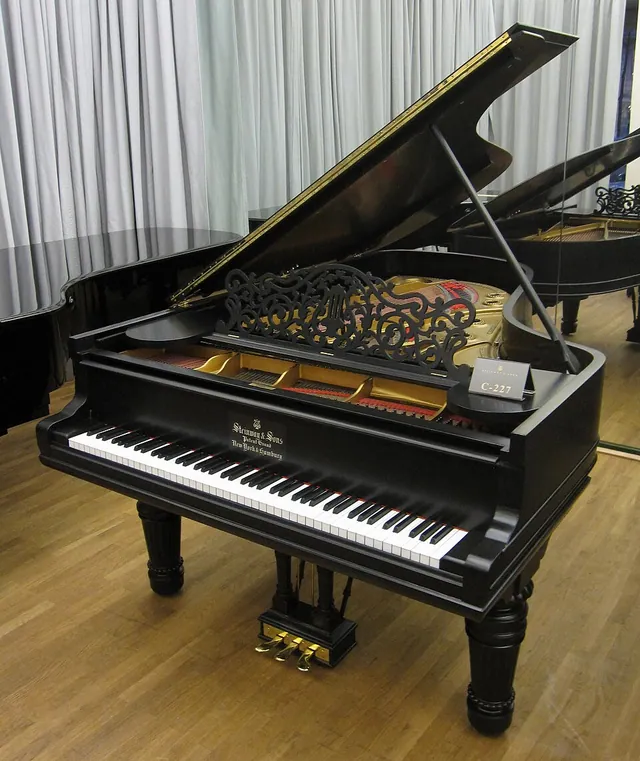
A piano is a keyboard instrument that produces sound when its keys are pressed, activating an action mechanism where hammers strike strings. Modern pianos have a row of 88 black and white keys—with the exception of the Bosendörfer and Stuart & Sons pianos—and tuned to a chromatic scale in equal temperament. A musician who specializes in piano is called a pianist.
There are two main types of piano: the grand piano and the upright piano. The grand piano offers better sound and more precise key control, making it the preferred choice when space and budget allow. The grand piano is also considered a necessity in venues hosting skilled pianists. The upright piano is more commonly used because of its smaller size and lower cost.
When a key is depressed, the strings inside are struck by felt-coated wooden hammers. The vibrations are transmitted through a bridge to a soundboard that amplifies the sound by coupling the acoustic energy to the air. When the key is released, a damper stops the string's vibration, ending the sound. Most notes have three strings, except for the bass, which graduates from one to two. Notes can be sustained when the keys are released by the use of pedals at the base of the instrument, which lift the dampers off the strings. The sustain pedal allows pianists to connect and overlay sound, and achieve expressive and colorful sonority.
Text adapted from the Wikipedia article “Piano”, licensed under CC BY-SA 4.0.
Listen
Recordings from Wikimedia Commons, found via Openverse.
Frequently asked questions
What is the range of the piano?
The practical written range of the piano is A0 to C8, which sounds A0 to C8 (27.5 Hz to 4186 Hz at A4 = 440 Hz).
Is the piano a transposing instrument?
No. The piano sounds at written pitch (concert pitch).
What clef does the piano read?
The piano reads treble clef and bass clef.
How is the piano classified?
In the Hornbostel–Sachs system the piano is classified as 314.122-4-8.