Bowed strings · Bowed · Violin family
Cello
Tuned an octave below the viola: C2, G2, D3, A3.
Quick facts
| Family | Bowed strings — Bowed |
|---|---|
| Hornbostel–Sachs | 321.322-71 |
| Pitched in | C |
| Transposition | Sounds as written (non-transposing) |
| Written range | C2 – A5 |
| Sounding range | C2 – A5 (65.41 – 880 Hz) |
| Clefs | Bass, Tenor, Treble |
| Other names | V.Cello, Violoncello, cello de viola da braccio, violincello, violoncelle, violonchelo |
Player's notes
- Tuned an octave below the viola: C2, G2, D3, A3.
- Played seated with an endpin; reads bass, tenor and treble clef.
About the cello
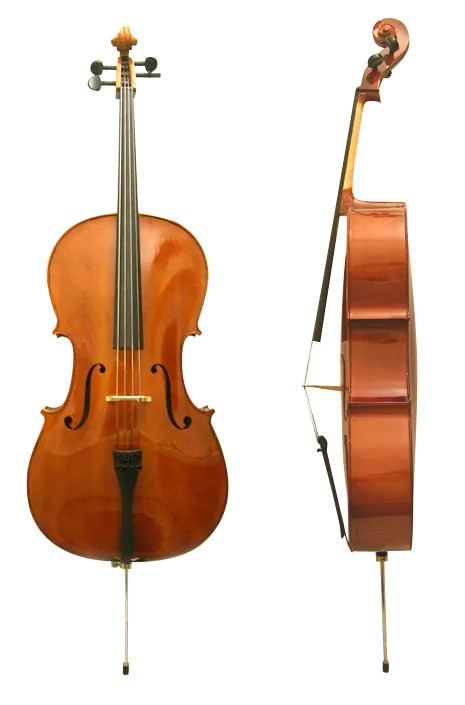
The violoncello ( VY-ə-lən-CHEL-oh, Italian pronunciation: [vjolonˈtʃɛllo]), commonly abbreviated as cello ( CHEL-oh), is a medium-low pitched bowed string instrument of the violin family. Its four strings are usually tuned in perfect fifths: from low to high, C2, G2, D3 and A3. The viola's four strings are each an octave higher. Music for the cello is generally written in the bass clef; the tenor clef and treble clef are used for higher-range passages.
Played by a cellist or violoncellist, the instrument enjoys a large solo repertoire with and without accompaniment, as well as numerous concerti. As a solo instrument, the cello uses its whole range, from bass to soprano, and in chamber music, such as string quartets and the orchestra's string section, it often plays the bass part, where it may be reinforced an octave lower by the double basses. Figured bass music of the Baroque era typically assumes a cello, viola da gamba or bassoon as part of the basso continuo group alongside chordal instruments such as organ, harpsichord, lute, or theorbo. Cellos are found in many other ensembles, from modern Chinese orchestras to cello rock bands.
Text adapted from the Wikipedia article “Cello”, licensed under CC BY-SA 4.0.
Listen
Recordings from Wikimedia Commons, found via Openverse.
Frequently asked questions
What is the range of the cello?
The practical written range of the cello is C2 to A5, which sounds C2 to A5 (65.4 Hz to 880 Hz at A4 = 440 Hz).
Is the cello a transposing instrument?
No. The cello sounds at written pitch (concert pitch).
What clef does the cello read?
The cello reads bass clef and tenor clef and treble clef.
How is the cello classified?
In the Hornbostel–Sachs system the cello is classified as 321.322-71.