Bowed strings · Bowed · Violin family
Double Bass
Sounds an octave lower than written; tuned in fourths E1, A1, D2, G2.
Quick facts
| Family | Bowed strings — Bowed |
|---|---|
| Hornbostel–Sachs | 321.322-71 |
| Pitched in | C |
| Transposition | Sounds a octave lower than written |
| Written range | E2 – G4 |
| Sounding range | E1 – G3 (41.20 – 196 Hz) |
| Clef | Bass |
| First appeared | c. 1400 |
| Other names | Kontrabass, acoustic upright bass, basso de viola, bull fiddle, contrabaixo, contrabajo, contrabass, contrabbasso, contrebasse, stand-up bass |
Player's notes
- Sounds an octave lower than written; tuned in fourths E1, A1, D2, G2.
- Many orchestral basses add a low C extension.
About the double bass
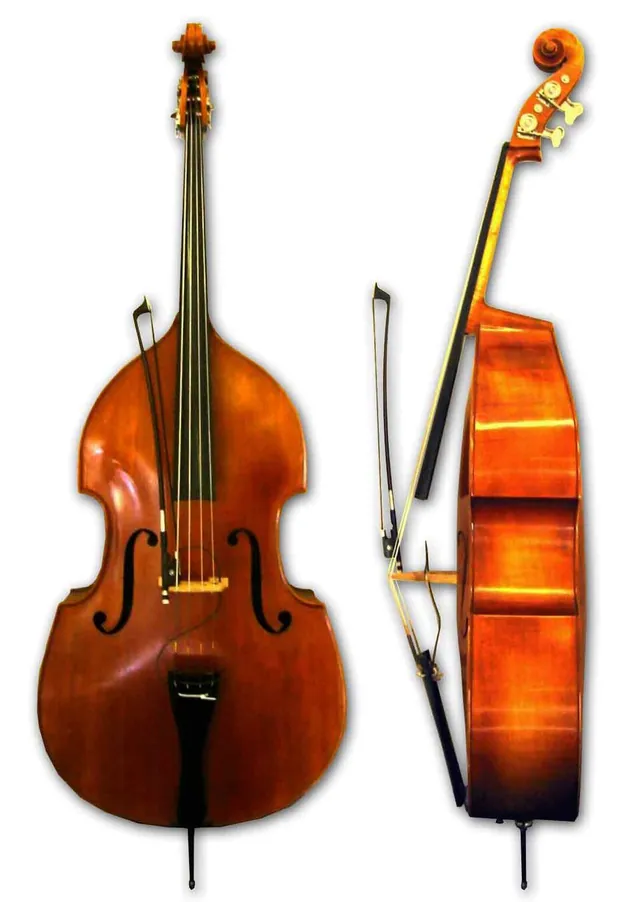
The double bass, also known as the upright bass, the acoustic bass, the bull fiddle, the bass fiddle, the string bass, the contrabass, or simply the bass, is the largest and lowest-pitched chordophone in the modern symphony orchestra (excluding rare additions such as the octobass). It has four or five strings, and its construction is in between that of the gamba (viol) and the violin family.
The bass is a standard member of the orchestra's string section, along with violins, violas, and cellos, as well as the concert band, and is featured in concertos, solo, and chamber music in Western classical music. The bass is used in a range of other genres, such as jazz, blues, rock and roll, rockabilly, country music, bluegrass, tango, folk music and certain types of film and video game soundtracks.
The instrument's exact lineage is still a matter of some debate, with scholars divided on whether the bass is derived from the viol or the violin family.
Text adapted from the Wikipedia article “Double bass”, licensed under CC BY-SA 4.0.
Listen
Recordings from Wikimedia Commons, found via Openverse.
Frequently asked questions
What is the range of the double bass?
The practical written range of the double bass is E2 to G4, which sounds E1 to G3 (41.2 Hz to 196 Hz at A4 = 440 Hz).
Is the double bass a transposing instrument?
Yes. The double bass is pitched in C: sounds a octave lower than written. A written C sounds C.
What clef does the double bass read?
The double bass reads bass clef.
How is the double bass classified?
In the Hornbostel–Sachs system the double bass is classified as 321.322-71.