Pitched percussion · Struck bars · Mallet percussion
Glockenspiel
Steel bars sounding two octaves above written pitch.
Quick facts
| Family | Pitched percussion — Struck bars |
|---|---|
| Hornbostel–Sachs | 111.212 |
| Pitched in | C |
| Transposition | Sounds a two octaves higher than written |
| Written range | G3 – C6 |
| Sounding range | G5 – C8 (783.99 – 4186 Hz) |
| Clef | Treble |
| Materials | aluminium, steel |
| Other names | campanelli, carillon, glocknspui, klokɛnspiili, orchestra bells, orchestral bells, дзвіночки |
Player's notes
- Steel bars sounding two octaves above written pitch.
About the glockenspiel
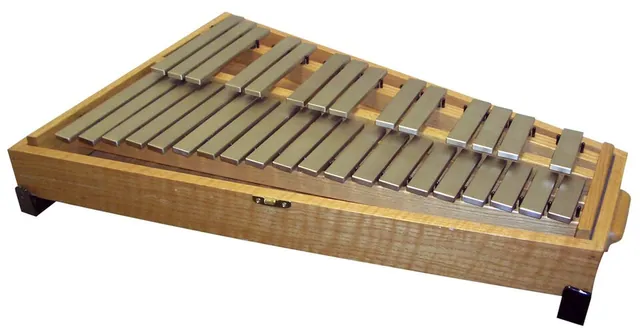
The glockenspiel ( GLO-kən-shpeel; German pronunciation: [ˈɡlɔkənˌʃpiːl] or [ˈɡlɔkn̩ˌʃpiːl], Glocken: bells and Spiel: play) or bells is a percussion instrument consisting of pitched aluminum or steel bars arranged in a keyboard layout. This makes the glockenspiel a type of metallophone, similar to the vibraphone.
The glockenspiel is played by striking the bars with mallets, often made of a hard material such as metal or plastic. Its clear, high-pitched tone is often heard in orchestras, wind ensembles, marching bands, and in popular music.
Text adapted from the Wikipedia article “Glockenspiel”, licensed under CC BY-SA 4.0.
Listen
Recordings from Wikimedia Commons, found via Openverse.
Frequently asked questions
What is the range of the glockenspiel?
The practical written range of the glockenspiel is G3 to C6, which sounds G5 to C8 (784.0 Hz to 4186 Hz at A4 = 440 Hz).
Is the glockenspiel a transposing instrument?
Yes. The glockenspiel is pitched in C: sounds a two octaves higher than written. A written C sounds C.
What clef does the glockenspiel read?
The glockenspiel reads treble clef.
How is the glockenspiel classified?
In the Hornbostel–Sachs system the glockenspiel is classified as 111.212.