Pitched percussion · Struck bars · Mallet percussion
Xylophone
Sounds an octave above written; bars tuned with a twelfth as first overtone gives its bright attack.

Quick facts
| Family | Pitched percussion — Struck bars |
|---|---|
| Hornbostel–Sachs | 111.212 |
| Pitched in | C |
| Transposition | Sounds a octave higher than written |
| Written range | F3 – C7 |
| Sounding range | F4 – C8 (349.23 – 4186 Hz) |
| Clef | Treble |
| Other names | Xylophon, xilófono |
Player's notes
- Sounds an octave above written; bars tuned with a twelfth as first overtone gives its bright attack.
About the xylophone
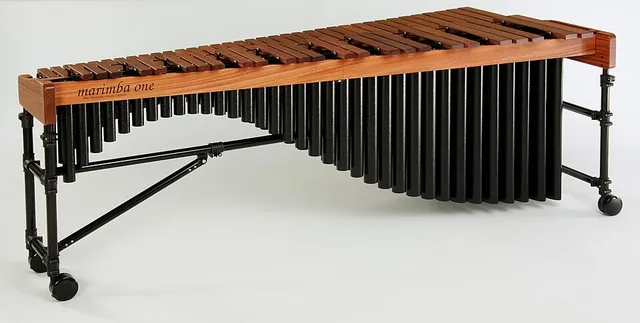
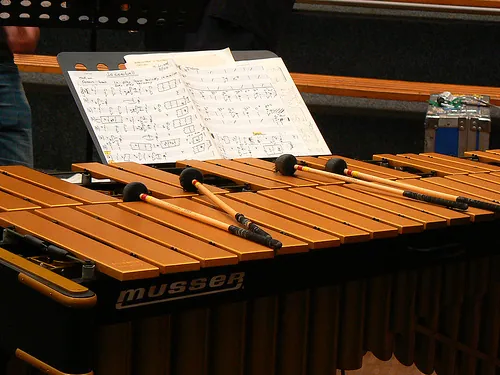
The xylophone (from Ancient Greek ξύλον (xúlon) 'wood' and φωνή (phōnḗ) 'sound, voice'; lit. 'sound of wood') is a musical instrument in the percussion family that consists of wooden bars struck by mallets. Each bar is an idiophone tuned to a pitch of a musical scale, whether pentatonic or heptatonic in the case of many African and Asian instruments, diatonic in many western children's instruments, or chromatic for orchestral use.
The term xylophone may be used generally, to include all such instruments such as the marimba, balafon and even the semantron. However, in the orchestra, the term xylophone refers specifically to a chromatic instrument of somewhat higher pitch range and drier timbre than the marimba, and these two instruments should not be confused. A person who plays the xylophone is known as a xylophonist or simply a xylophone player.
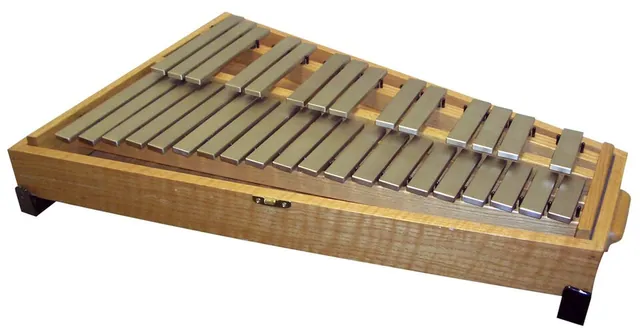
The term is also popularly used to refer to similar instruments of the lithophone and metallophone types. For example, the Pixiphone and many similar toys described by the makers as xylophones have bars of metal rather than of wood, and so are in organology regarded as glockenspiels rather than as xylophones.
Text adapted from the Wikipedia article “Xylophone”, licensed under CC BY-SA 4.0.
Listen
Recordings from Wikimedia Commons, found via Openverse.
Frequently asked questions
What is the range of the xylophone?
The practical written range of the xylophone is F3 to C7, which sounds F4 to C8 (349.2 Hz to 4186 Hz at A4 = 440 Hz).
Is the xylophone a transposing instrument?
Yes. The xylophone is pitched in C: sounds a octave higher than written. A written C sounds C.
What clef does the xylophone read?
The xylophone reads treble clef.
How is the xylophone classified?
In the Hornbostel–Sachs system the xylophone is classified as 111.212.