Pitched percussion · Struck bars · Mallet percussion
Marimba
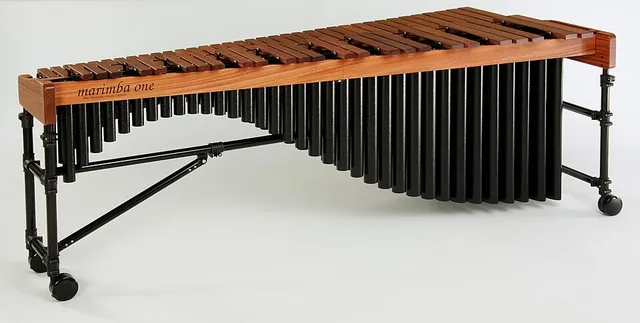
Rosewood or synthetic bars over tuned resonators; five-octave concert models span C2–C7.
Quick facts
| Family | Pitched percussion — Struck bars |
|---|---|
| Hornbostel–Sachs | 111.212 |
| Pitched in | C |
| Transposition | Sounds as written (non-transposing) |
| Written range | C2 – C7 |
| Sounding range | C2 – C7 (65.41 – 2093 Hz) |
| Clefs | Treble, Bass |
| Origin | Guatemala, Mexico |
| Other names | marimbaphone |
Player's notes
- Rosewood or synthetic bars over tuned resonators; five-octave concert models span C2–C7.
- Each bar is undercut so its first overtone sits two octaves above the fundamental.
About the marimba
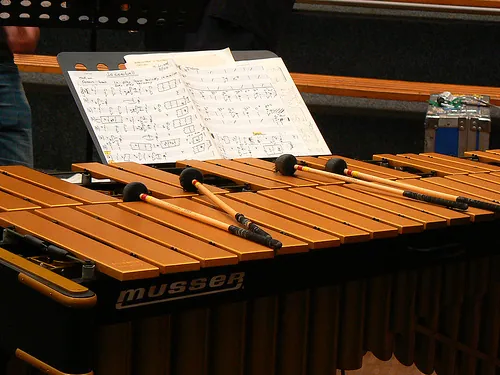
The marimba ( mə-RIM-bə) is a musical instrument in the percussion family that consists of wooden bars that are struck by mallets. Below each bar is a resonator pipe that amplifies particular harmonics of its sound. Compared to the xylophone, the marimba has a lower range. Typically, the bars of a marimba are arranged chromatically, like the keys of a piano. The marimba is a type of idiophone.
Today, the marimba is used as a solo instrument, or in ensembles like orchestras, marching bands (typically as a part of the front ensemble), percussion ensembles, brass and concert bands, and other traditional ensembles.
Text adapted from the Wikipedia article “Marimba”, licensed under CC BY-SA 4.0.
Listen
Recordings from Wikimedia Commons, found via Openverse.
Frequently asked questions
What is the range of the marimba?
The practical written range of the marimba is C2 to C7, which sounds C2 to C7 (65.4 Hz to 2093 Hz at A4 = 440 Hz).
Is the marimba a transposing instrument?
No. The marimba sounds at written pitch (concert pitch).
What clef does the marimba read?
The marimba reads treble clef and bass clef.
How is the marimba classified?
In the Hornbostel–Sachs system the marimba is classified as 111.212.