Pitched percussion · Struck membrane · Drums
Timpani
Kettle drums tuned by pedal; a standard set of four covers roughly D2–C4.
Quick facts
| Family | Pitched percussion — Struck membrane |
|---|---|
| Hornbostel–Sachs | 211.11-922 |
| Pitched in | C |
| Transposition | Sounds as written (non-transposing) |
| Written range | D2 – C4 |
| Sounding range | D2 – C4 (73.42 – 262 Hz) |
| Clef | Bass |
| Other names | Pauke, poyk, timbale classique, timbales (de concierto) / tímpanos |
Player's notes
- Kettle drums tuned by pedal; a standard set of four covers roughly D2–C4.
About the timpani
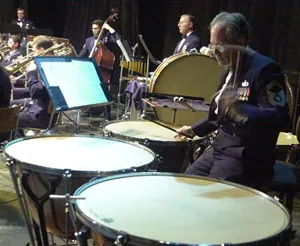
The timpani (; Italian pronunciation: [ˈtimpani]) or kettledrums (also informally called timps) are musical instruments in the percussion family. A type of drum categorised as a hemispherical drum, they consist of a membrane called a head stretched over a large bowl traditionally made of copper. Thus, timpani are an example of kettledrums, also known as vessel drums and semispherical drums, whose body is similar to a section of a sphere whose cut conforms the head. Most modern timpani are pedal timpani and can be tuned quickly and accurately to specific pitches by skilled players through the use of a movable foot-pedal. They are played by striking the head with a specialized beater called a timpani stick or timpani mallet. Timpani evolved from military drums to become a staple of the classical orchestra by the last third of the 18th century. Today, they are used in many types of ensembles, including concert bands, marching bands, orchestras, and even in some rock bands.
Timpani is an Italian plural, the singular of which is timpano, though the singular may also be referred to as a timpanum. In English, the term timpano is only widely used by practitioners: a single drum is often referred to as a timpani, leading many to incorrectly pluralize the word as timpanis. A musician who plays timpani is a timpanist.
Text adapted from the Wikipedia article “Timpani”, licensed under CC BY-SA 4.0.
Listen
Recordings from Wikimedia Commons, found via Openverse.
Frequently asked questions
What is the range of the timpani?
The practical written range of the timpani is D2 to C4, which sounds D2 to C4 (73.4 Hz to 262 Hz at A4 = 440 Hz).
Is the timpani a transposing instrument?
No. The timpani sounds at written pitch (concert pitch).
What clef does the timpani read?
The timpani reads bass clef.
How is the timpani classified?
In the Hornbostel–Sachs system the timpani is classified as 211.11-922.
Related instruments
Marimba
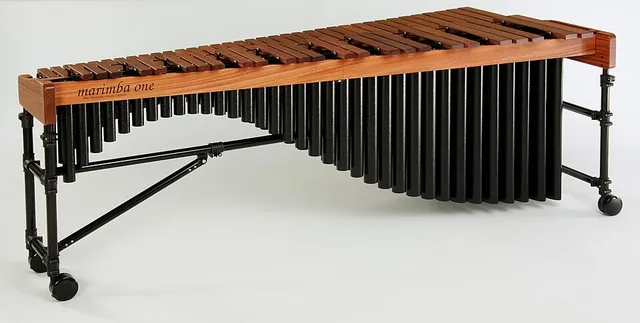
Rosewood or synthetic bars over tuned resonators; five-octave concert models span C2–C7.

Xylophone
Sounds an octave above written; bars tuned with a twelfth as first overtone gives its…
Glockenspiel
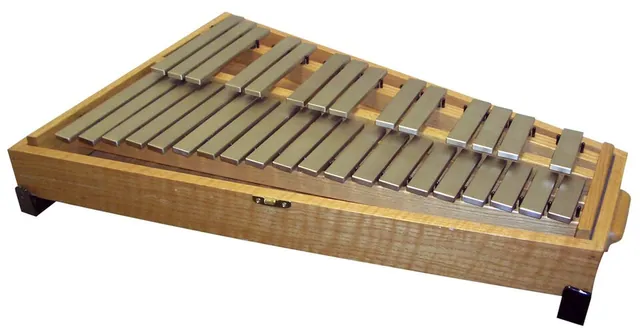
Steel bars sounding two octaves above written pitch.
Vibraphone
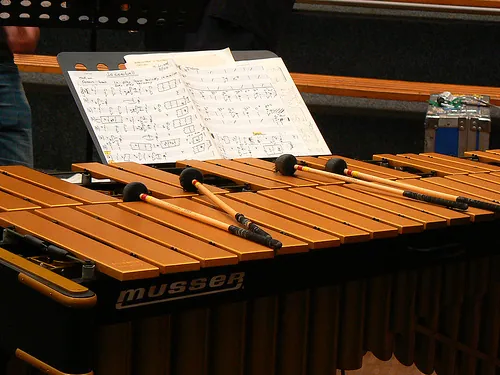
Aluminium bars, a sustain pedal and motor-driven resonator fans that create vibrato.