Recorder · Second octave register
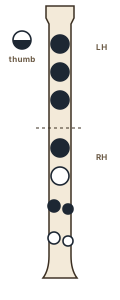
Recorder fingering for F5
Thumb hole half-covered (pinched); left index hole; left middle hole; left ring hole; right index hole; both right-ring holes. Baroque fingering.
What it sounds like
| Instrument | Sounding pitch | Frequency (A4 = 440 Hz) | |
|---|---|---|---|
| Soprano recorder | F6 | 1,396.91 Hz | |
| Tenor recorder | F5 | 698.46 Hz |
Tip for the second octave register
The upper register is opened by pinching the thumb hole (a small gap at the top of the hole). Blow slightly faster air as you go higher.
Frequently asked questions
How do you play F5 on the recorder?
Standard fingering: Thumb hole half-covered (pinched); left index hole; left middle hole; left ring hole; right index hole; both right-ring holes. Baroque fingering.
What does written F5 sound like on the recorder?
Soprano recorder: F6 (1396.9 Hz); Tenor recorder: F5 (698.5 Hz).
Are there alternate fingerings for F5?
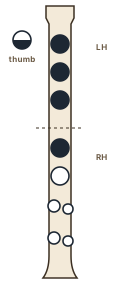
Yes — 1 alternate: (1) Thumb hole half-covered (pinched); left index hole; left middle hole; left ring hole; right index hole. German-system fingering.