Tonehole

Recorder · Second octave register

Recorder fingering for F♯5 / G♭5

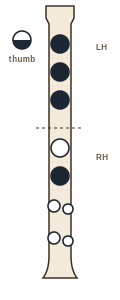
Thumb hole half-covered (pinched); left index hole; left middle hole; left ring hole; right middle hole. Baroque fingering.
Full chart Check with tuner
Recorder F♯5 fingering: Thumb hole half-covered (pinched); left index hole; left middle hole; left ring hole; right middle hole.
Standard fingeringThumb hole half-covered (pinched); left index hole; left middle hole; left ring hole; right middle hole.Baroque fingering.
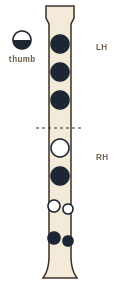
Recorder F♯5 fingering (alternate 1): Thumb hole half-covered (pinched); left index hole; left middle hole; left ring hole; right middle hole; both right-pinky holes.
Alternate 1Thumb hole half-covered (pinched); left index hole; left middle hole; left ring hole; right middle hole; both right-pinky holes.German-system fingering.
Written noteF sharp 5 — F#5 in scientific pitch notation.

What it sounds like

InstrumentSounding pitchFrequency (A4 = 440 Hz)
Soprano recorderF♯61,479.98 Hz
Tenor recorderF♯5739.99 Hz

Tip for the second octave register

The upper register is opened by pinching the thumb hole (a small gap at the top of the hole). Blow slightly faster air as you go higher.

Frequently asked questions

How do you play F♯5 (G♭5) on the recorder?

Standard fingering: Thumb hole half-covered (pinched); left index hole; left middle hole; left ring hole; right middle hole. Baroque fingering.

What does written F♯5 sound like on the recorder?

Soprano recorder: F♯6 (1480.0 Hz); Tenor recorder: F♯5 (740.0 Hz).

Are there alternate fingerings for F♯5?

Yes — 1 alternate: (1) Thumb hole half-covered (pinched); left index hole; left middle hole; left ring hole; right middle hole; both right-pinky holes. German-system fingering.

Latest posts

  1. Essential Skills for Playing Wind Instruments Effectively
  2. Overlooked Details in Saxophone Articulation Techniques
  3. How Context Changes Mouthpiece Comparison
  4. Building a Flute Low Register Checklist for Better Tone
  5. Context and Woodwind Scale Practice Strategies
  6. Evaluating Saxophone Embouchure Advice for Better Tone
  7. Developing a Strong Flute Low Register for Better Tone
  8. Is Clarinet the Hardest Instrument to Learn? Reality Check
  9. Natural Minor Scales Overlooked Details and Hidden Nuances
  10. Common Woodwind Practice Myths and How to Plan Better