Recorder · First octave register
Recorder fingering for F♯4 / G♭4
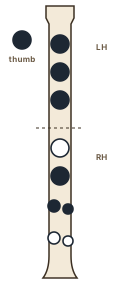
Thumb hole; left index hole; left middle hole; left ring hole; right middle hole; both right-ring holes. Baroque fingering.
What it sounds like
| Instrument | Sounding pitch | Frequency (A4 = 440 Hz) | |
|---|---|---|---|
| Soprano recorder | F♯5 | 739.99 Hz | |
| Tenor recorder | F♯4 | 369.99 Hz |
Tip for the first octave register
Cover holes with the soft pads of your fingers. Use very gentle air on the lowest notes — the recorder overblows easily.
Frequently asked questions
How do you play F♯4 (G♭4) on the recorder?
Standard fingering: Thumb hole; left index hole; left middle hole; left ring hole; right middle hole; both right-ring holes. Baroque fingering.
What does written F♯4 sound like on the recorder?
Soprano recorder: F♯5 (740.0 Hz); Tenor recorder: F♯4 (370.0 Hz).
Are there alternate fingerings for F♯4?
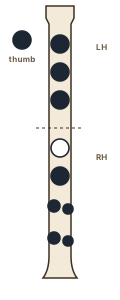
Yes — 1 alternate: (1) Thumb hole; left index hole; left middle hole; left ring hole; right middle hole; both right-ring holes; both right-pinky holes. German-system fingering.