Brass · Lip-reed (valved) · Horn family
French Horn
Horn in F sounds a perfect fifth lower than written.
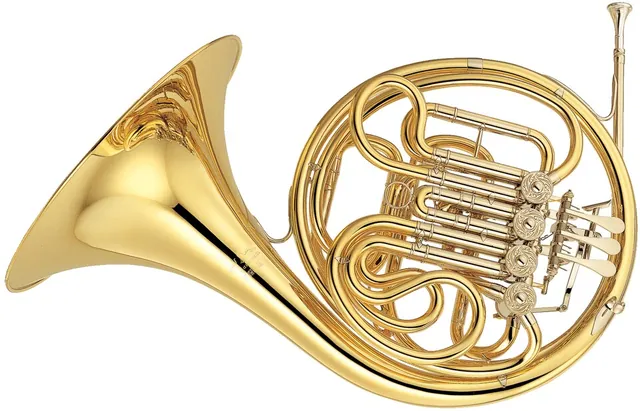
Quick facts
| Family | Brass — Lip-reed (valved) |
|---|---|
| Hornbostel–Sachs | 423.232 |
| Pitched in | F |
| Transposition | Sounds a perfect fifth lower than written |
| Written range | F♯2 – C6 |
| Sounding range | B1 – F5 (61.74 – 698 Hz) |
| Clefs | Treble, Bass |
| Other names | Cor d'harmonie, Waldhorn, cuerno francés |
Player's notes
- Horn in F sounds a perfect fifth lower than written.
- The double horn adds a B♭ side switched by a thumb valve.
- The right hand in the bell shapes tone and pitch.
About the french horn
The horn is a brass instrument in the horn family, made of tubing wrapped into a coil with a large flared bell and rotary valves. The term French horn refers to horns with piston valves, seldom used today; the double horn in F/B♭, a variety of German horn, is the horn most often used by players in professional orchestras and bands, although the descant and triple horn have become increasingly popular. A musician who plays a horn is known as a horn player or hornist.
Pitch is controlled through the combination of the following factors: speed of air through the instrument (controlled by the player's lungs and thoracic diaphragm); diameter and tension of lip aperture (by the player's lip muscles—the embouchure) in the mouthpiece; plus, in a modern horn, the operation of valves by the left hand, which route the air into extra sections of tubing. Most horns have lever-operated rotary valves, but some, especially older horns, use piston valves (similar to a trumpet's) and the Vienna horn uses double-piston valves, or pumpenventil. The backward-facing orientation of the bell relates to the perceived desirability to create a subdued sound in concert situations, in contrast to the more piercing quality of the trumpet. A horn without valves is known as a natural horn, changing pitch along the natural harmonics of the instrument, similar to a bugle. Pitch may also be controlled by the position of the hand in the bell, in effect reducing the bell's diameter. The pitch of any note can easily be raised or lowered by adjusting the hand position in the bell. The key of a natural horn can be changed by adding different crooks of different lengths.
Three valves control the flow of air in the single horn, which is tuned to F or less commonly B♭. The more common double horn has a fourth, trigger valve, usually operated by the thumb, which routes the air to one set of tubing tuned to F or another tuned to B♭ which expands the horn range to over four octaves and blends with flutes or clarinets in a woodwind ensemble. Triple horns with five valves are also made, usually tuned in F, B♭, and a descant E♭ or F. There are also double horns with five valves tuned in B♭, descant E♭ or F, and a stopping valve, which greatly simplifies the complicated and difficult hand-stopping technique, though these are rarer. Also common are descant doubles, which typically provide B♭ and alto F branches.
Text adapted from the Wikipedia article “French horn”, licensed under CC BY-SA 4.0.
Listen
Recordings from Wikimedia Commons, found via Openverse.
Frequently asked questions
What is the range of the french horn?
The practical written range of the french horn is F♯2 to C6, which sounds B1 to F5 (61.7 Hz to 698 Hz at A4 = 440 Hz).
Is the french horn a transposing instrument?
Yes. The french horn is pitched in F: sounds a perfect fifth lower than written. A written C sounds F.
What clef does the french horn read?
The french horn reads treble clef and bass clef.
How is the french horn classified?
In the Hornbostel–Sachs system the french horn is classified as 423.232.
Related instruments
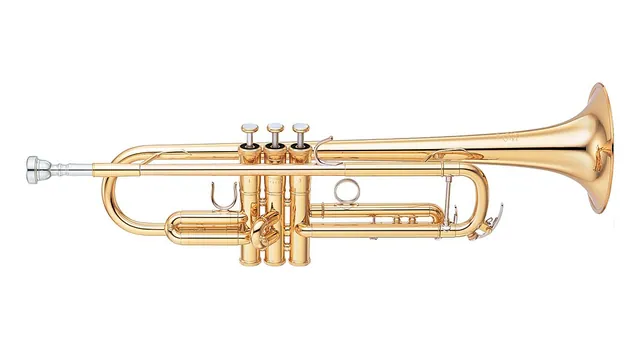
Trumpet
B♭ trumpet sounds a whole step lower than written; orchestral players also use C trumpets.
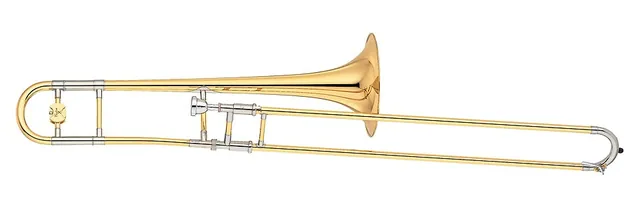
Trombone
Non-transposing in orchestral music; seven slide positions.
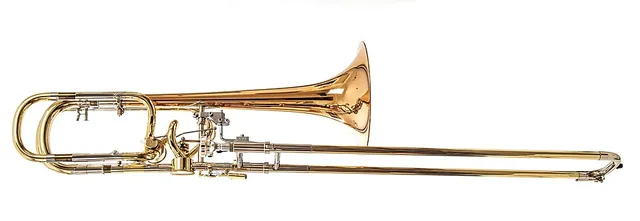
Bass Trombone
Wider bore and bell than the tenor, with one or two valve attachments.
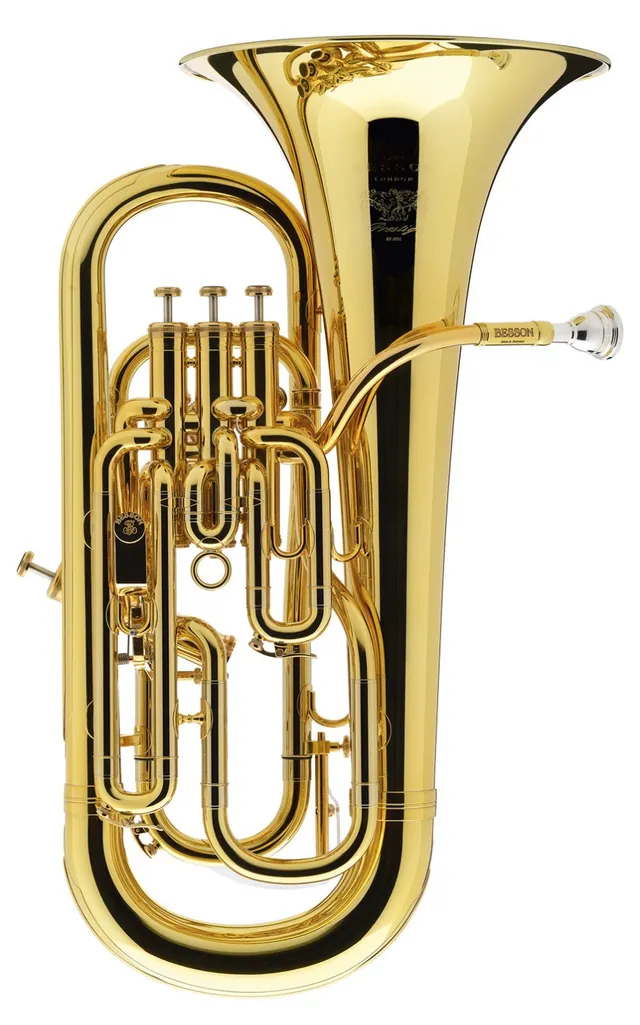
Euphonium
Conical-bore tenor tuba; in bass clef it reads at concert pitch.
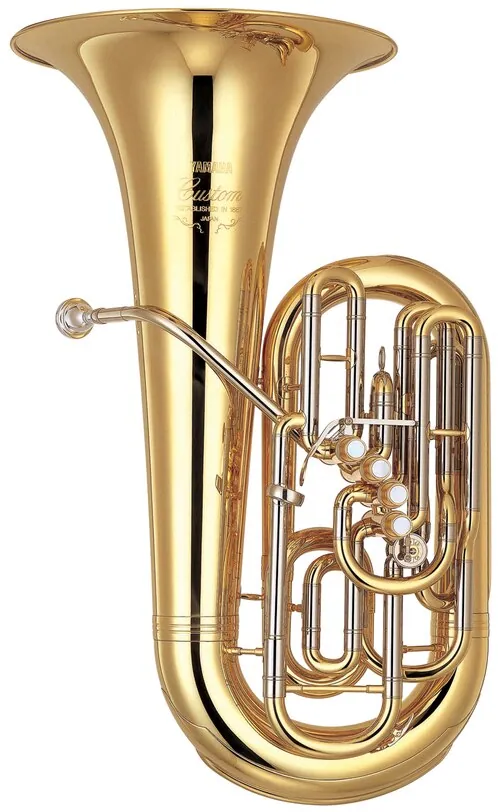
Tuba
Built in B♭, C, E♭ or F but always written at concert pitch in orchestral music.