Flute · Second octave register
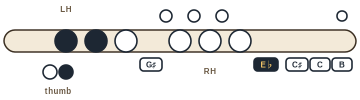
Flute fingering for A5
Left hand 1-2, B thumb key, E♭ key (right pinky). Basic.
What it sounds like
| Instrument | Sounding pitch | Frequency (A4 = 440 Hz) | |
|---|---|---|---|
| Flute | A5 | 880.00 Hz | |
| Piccolo | A6 | 1,760.00 Hz | |
| Alto flute (G) | E5 | 659.26 Hz | |
| Bass flute | A4 | 440.00 Hz |
Tip for the second octave register
The second octave uses mostly the same fingerings as the first; raise the pitch with faster air and a smaller aperture, not by blowing harder. Note the open left index finger on D and E♭.
Frequently asked questions
How do you play A5 on the flute?
Standard fingering: Left hand 1-2, B thumb key, E♭ key (right pinky). Basic.
What does written A5 sound like on the flute?
Flute: A5 (880.0 Hz); Piccolo: A6 (1760.0 Hz); Alto flute (G): E5 (659.3 Hz); Bass flute: A4 (440.0 Hz).