Flute · First octave register
Flute fingering for B♭4 / A♯4
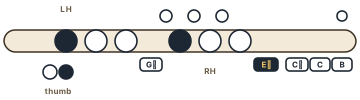
Left hand 1, right hand 1, B thumb key, E♭ key (right pinky). Basic '1 and 1' B♭.
What it sounds like
| Instrument | Sounding pitch | Frequency (A4 = 440 Hz) | |
|---|---|---|---|
| Flute | B♭4 | 466.16 Hz | |
| Piccolo | B♭5 | 932.33 Hz | |
| Alto flute (G) | F4 | 349.23 Hz | |
| Bass flute | B♭3 | 233.08 Hz |
Tip for the first octave register
Low notes speak with a relaxed, slightly larger aperture and slower air directed more down into the embouchure hole. Check that every pad seals — low C is the first note to suffer from leaks.
Frequently asked questions
How do you play B♭4 (A♯4) on the flute?
Standard fingering: Left hand 1, right hand 1, B thumb key, E♭ key (right pinky). Basic '1 and 1' B♭.
What does written B♭4 sound like on the flute?
Flute: B♭4 (466.2 Hz); Piccolo: B♭5 (932.3 Hz); Alto flute (G): F4 (349.2 Hz); Bass flute: B♭3 (233.1 Hz).
Are there alternate fingerings for B♭4?
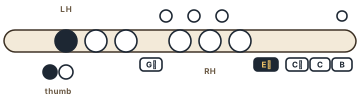
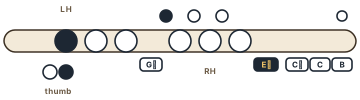
Yes — 2 alternate: (1) Left hand 1, B♭ thumb lever, E♭ key (right pinky). Thumb B♭ — for flat keys without B natural. (2) Left hand 1, B thumb key, B♭ trill key, E♭ key (right pinky). Trill fingering with B.