Flute · Second octave register
Flute fingering for F5
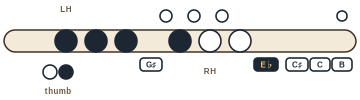
Left hand 1-2-3, right hand 1, B thumb key, E♭ key (right pinky). Basic.
What it sounds like
| Instrument | Sounding pitch | Frequency (A4 = 440 Hz) | |
|---|---|---|---|
| Flute | F5 | 698.46 Hz | |
| Piccolo | F6 | 1,396.91 Hz | |
| Alto flute (G) | C5 | 523.25 Hz | |
| Bass flute | F4 | 349.23 Hz |
Tip for the second octave register
The second octave uses mostly the same fingerings as the first; raise the pitch with faster air and a smaller aperture, not by blowing harder. Note the open left index finger on D and E♭.
Frequently asked questions
How do you play F5 on the flute?
Standard fingering: Left hand 1-2-3, right hand 1, B thumb key, E♭ key (right pinky). Basic.
What does written F5 sound like on the flute?
Flute: F5 (698.5 Hz); Piccolo: F6 (1396.9 Hz); Alto flute (G): C5 (523.3 Hz); Bass flute: F4 (349.2 Hz).