Flute · Second octave register
Flute fingering for B♭5 / A♯5
Left hand 1, right hand 1, B thumb key, E♭ key (right pinky). Basic.
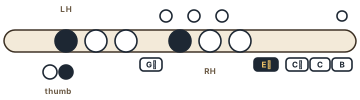
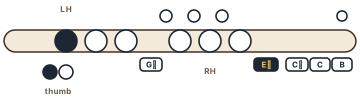
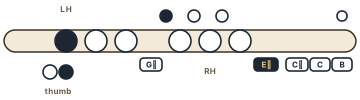
What it sounds like
| Instrument | Sounding pitch | Frequency (A4 = 440 Hz) | |
|---|---|---|---|
| Flute | B♭5 | 932.33 Hz | |
| Piccolo | B♭6 | 1,864.66 Hz | |
| Alto flute (G) | F5 | 698.46 Hz | |
| Bass flute | B♭4 | 466.16 Hz |
Tip for the second octave register
The second octave uses mostly the same fingerings as the first; raise the pitch with faster air and a smaller aperture, not by blowing harder. Note the open left index finger on D and E♭.
Frequently asked questions
How do you play B♭5 (A♯5) on the flute?
Standard fingering: Left hand 1, right hand 1, B thumb key, E♭ key (right pinky). Basic.
What does written B♭5 sound like on the flute?
Flute: B♭5 (932.3 Hz); Piccolo: B♭6 (1864.7 Hz); Alto flute (G): F5 (698.5 Hz); Bass flute: B♭4 (466.2 Hz).
Are there alternate fingerings for B♭5?
Yes — 2 alternate: (1) Left hand 1, B♭ thumb lever, E♭ key (right pinky). Thumb B♭. (2) Left hand 1, B thumb key, B♭ trill key, E♭ key (right pinky). Trill fingering with B.