Saxophone · Low register register
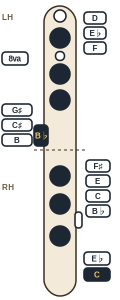
Saxophone fingering for B♭3 / A♯3
Left hand 1-2-3, right hand 1-2-3, low B♭ key, low C key (right pinky). Basic — lowest note.
What it sounds like
| Instrument | Sounding pitch | Frequency (A4 = 440 Hz) | |
|---|---|---|---|
| Soprano sax (B♭) | A♭3 | 207.65 Hz | |
| Alto sax (E♭) | D♭3 | 138.59 Hz | |
| Tenor sax (B♭) | A♭2 | 103.83 Hz | |
| Baritone sax (E♭) | D♭2 | 69.30 Hz |
Tip for the low register register
Low notes need more mouthpiece-in-mouth stability and an open throat; avoid pinching. Subtone practice (soft low notes) builds control.
Frequently asked questions
How do you play B♭3 (A♯3) on the saxophone?
Standard fingering: Left hand 1-2-3, right hand 1-2-3, low B♭ key, low C key (right pinky). Basic — lowest note.
What does written B♭3 sound like on the saxophone?
Soprano sax (B♭): A♭3 (207.7 Hz); Alto sax (E♭): D♭3 (138.6 Hz); Tenor sax (B♭): A♭2 (103.8 Hz); Baritone sax (E♭): D♭2 (69.3 Hz).