Saxophone · Low register register
Saxophone fingering for B♭4 / A♯4
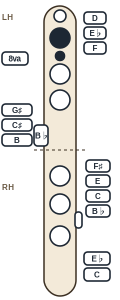
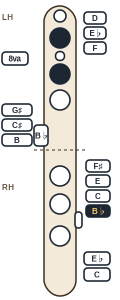
Left hand 1, bis B♭ key. Bis B♭ — for passages without B natural.
What it sounds like
| Instrument | Sounding pitch | Frequency (A4 = 440 Hz) | |
|---|---|---|---|
| Soprano sax (B♭) | A♭4 | 415.30 Hz | |
| Alto sax (E♭) | D♭4 | 277.18 Hz | |
| Tenor sax (B♭) | A♭3 | 207.65 Hz | |
| Baritone sax (E♭) | D♭3 | 138.59 Hz |
Tip for the low register register
Low notes need more mouthpiece-in-mouth stability and an open throat; avoid pinching. Subtone practice (soft low notes) builds control.
Frequently asked questions
How do you play B♭4 (A♯4) on the saxophone?
Standard fingering: Left hand 1, bis B♭ key. Bis B♭ — for passages without B natural.
What does written B♭4 sound like on the saxophone?
Soprano sax (B♭): A♭4 (415.3 Hz); Alto sax (E♭): D♭4 (277.2 Hz); Tenor sax (B♭): A♭3 (207.7 Hz); Baritone sax (E♭): D♭3 (138.6 Hz).
Are there alternate fingerings for B♭4?
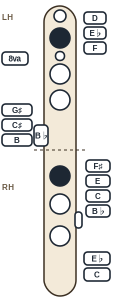
Yes — 2 alternate: (1) Left hand 1, right hand 1. 'One and one' B♭ — use next to F or F♯. (2) Left hand 1-2, side B♭ key. Side B♭ — A fingering plus the side key.