Saxophone · Middle register register
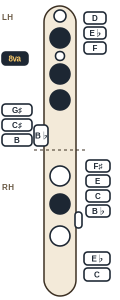
Saxophone fingering for F♯5 / G♭5
Left hand 1-2-3, right hand 2, octave key. Basic.
What it sounds like
| Instrument | Sounding pitch | Frequency (A4 = 440 Hz) | |
|---|---|---|---|
| Soprano sax (B♭) | E5 | 659.26 Hz | |
| Alto sax (E♭) | A4 | 440.00 Hz | |
| Tenor sax (B♭) | E4 | 329.63 Hz | |
| Baritone sax (E♭) | A3 | 220.00 Hz |
Tip for the middle register register
The octave key switches the left-thumb vent automatically between two holes. Middle D and E♭ can be unstable — keep a consistent voicing and don't bite.
Frequently asked questions
How do you play F♯5 (G♭5) on the saxophone?
Standard fingering: Left hand 1-2-3, right hand 2, octave key. Basic.
What does written F♯5 sound like on the saxophone?
Soprano sax (B♭): E5 (659.3 Hz); Alto sax (E♭): A4 (440.0 Hz); Tenor sax (B♭): E4 (329.6 Hz); Baritone sax (E♭): A3 (220.0 Hz).
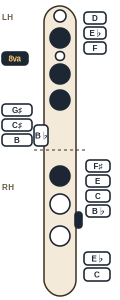
Are there alternate fingerings for F♯5?
Yes — 1 alternate: (1) Left hand 1-2-3, right hand 1, octave key, alternate F♯ key. Alternate F♯ key.