Saxophone · Low register register
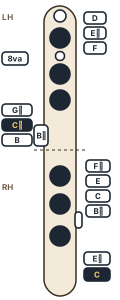
Saxophone fingering for C♯4 / D♭4
Left hand 1-2-3, right hand 1-2-3, low C♯ key, low C key (right pinky). Basic.
What it sounds like
| Instrument | Sounding pitch | Frequency (A4 = 440 Hz) | |
|---|---|---|---|
| Soprano sax (B♭) | B3 | 246.94 Hz | |
| Alto sax (E♭) | E3 | 164.81 Hz | |
| Tenor sax (B♭) | B2 | 123.47 Hz | |
| Baritone sax (E♭) | E2 | 82.41 Hz |
Tip for the low register register
Low notes need more mouthpiece-in-mouth stability and an open throat; avoid pinching. Subtone practice (soft low notes) builds control.
Frequently asked questions
How do you play C♯4 (D♭4) on the saxophone?
Standard fingering: Left hand 1-2-3, right hand 1-2-3, low C♯ key, low C key (right pinky). Basic.
What does written C♯4 sound like on the saxophone?
Soprano sax (B♭): B3 (246.9 Hz); Alto sax (E♭): E3 (164.8 Hz); Tenor sax (B♭): B2 (123.5 Hz); Baritone sax (E♭): E2 (82.4 Hz).