Saxophone · Palm-key register register
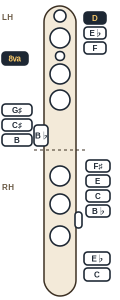
Saxophone fingering for D6
Octave key, palm D key. Basic — first palm key.
What it sounds like
| Instrument | Sounding pitch | Frequency (A4 = 440 Hz) | |
|---|---|---|---|
| Soprano sax (B♭) | C6 | 1,046.50 Hz | |
| Alto sax (E♭) | F5 | 698.46 Hz | |
| Tenor sax (B♭) | C5 | 523.25 Hz | |
| Baritone sax (E♭) | F4 | 349.23 Hz |
Tip for the palm-key register register
Palm-key notes are often sharp and thin. Open the throat, lower the jaw slightly and roll the palm keys rather than jab at them.
Frequently asked questions
How do you play D6 on the saxophone?
Standard fingering: Octave key, palm D key. Basic — first palm key.
What does written D6 sound like on the saxophone?
Soprano sax (B♭): C6 (1046.5 Hz); Alto sax (E♭): F5 (698.5 Hz); Tenor sax (B♭): C5 (523.3 Hz); Baritone sax (E♭): F4 (349.2 Hz).