Saxophone · Palm-key register register
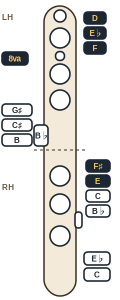
Saxophone fingering for F♯6 / G♭6
Octave key, palm D key, palm E♭ key, palm F key, side E key, high F♯ key. High F♯ key (most modern saxophones).
What it sounds like
| Instrument | Sounding pitch | Frequency (A4 = 440 Hz) | |
|---|---|---|---|
| Soprano sax (B♭) | E6 | 1,318.51 Hz | |
| Alto sax (E♭) | A5 | 880.00 Hz | |
| Tenor sax (B♭) | E5 | 659.26 Hz | |
| Baritone sax (E♭) | A4 | 440.00 Hz |
Tip for the palm-key register register
Palm-key notes are often sharp and thin. Open the throat, lower the jaw slightly and roll the palm keys rather than jab at them.
Frequently asked questions
How do you play F♯6 (G♭6) on the saxophone?
Standard fingering: Octave key, palm D key, palm E♭ key, palm F key, side E key, high F♯ key. High F♯ key (most modern saxophones).
What does written F♯6 sound like on the saxophone?
Soprano sax (B♭): E6 (1318.5 Hz); Alto sax (E♭): A5 (880.0 Hz); Tenor sax (B♭): E5 (659.3 Hz); Baritone sax (E♭): A4 (440.0 Hz).