Clarinet · Clarion register
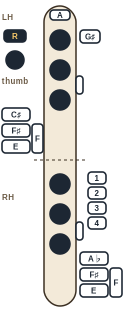
Clarinet fingering for D5
Thumb hole, left hand 1-2-3, right hand 1-2-3, register key. Basic.
What it sounds like
| Instrument | Sounding pitch | Frequency (A4 = 440 Hz) | |
|---|---|---|---|
| B♭ clarinet | C5 | 523.25 Hz | |
| A clarinet | B4 | 493.88 Hz | |
| E♭ clarinet | F5 | 698.46 Hz | |
| Bass clarinet | C4 | 261.63 Hz |
Tip for the clarion register
The register key turns each chalumeau fingering into the note a twelfth higher. Keep air speed up and the embouchure steady; don't bite to make notes speak.
Frequently asked questions
How do you play D5 on the clarinet?
Standard fingering: Thumb hole, left hand 1-2-3, right hand 1-2-3, register key. Basic.
What does written D5 sound like on the clarinet?
B♭ clarinet: C5 (523.3 Hz); A clarinet: B4 (493.9 Hz); E♭ clarinet: F5 (698.5 Hz); Bass clarinet: C4 (261.6 Hz).