Clarinet · Throat register
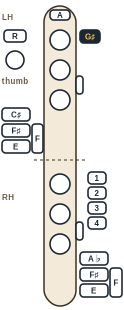
Clarinet fingering for G♯4 / A♭4
G♯ key (side of left index). Basic — G♯ key with the side of the left index.
What it sounds like
| Instrument | Sounding pitch | Frequency (A4 = 440 Hz) | |
|---|---|---|---|
| B♭ clarinet | F♯4 | 369.99 Hz | |
| A clarinet | E♯4 | 349.23 Hz | |
| E♭ clarinet | B4 | 493.88 Hz | |
| Bass clarinet | F♯3 | 185.00 Hz |
Tip for the throat register
The throat tones are naturally weaker and brighter. Try resting right-hand fingers down (or using side-key fingerings) to add resonance and steadiness without changing the pitch much.
Frequently asked questions
How do you play G♯4 (A♭4) on the clarinet?
Standard fingering: G♯ key (side of left index). Basic — G♯ key with the side of the left index.
What does written G♯4 sound like on the clarinet?
B♭ clarinet: F♯4 (370.0 Hz); A clarinet: E♯4 (349.2 Hz); E♭ clarinet: B4 (493.9 Hz); Bass clarinet: F♯3 (185.0 Hz).